


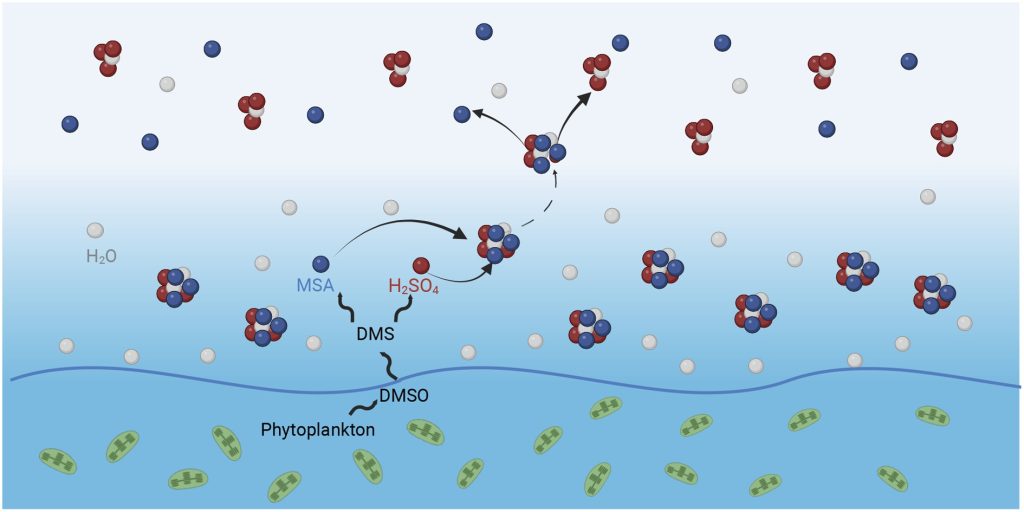
Methanesulfonic acid (MSA) contributes to atmospheric new particle formation and growth – Yu et al., Environ. Sci.: Atmos. 2026; https://doi.org/10.1039/d5ea00123d
Marine clouds are one of the most important regulators of global climate – however, they are also one of the biggest uncertainties in climate models. Two new studies recently published in Environmental Science: Atmospheres shed light on a previously overlooked driver of marine cloud formation: methanesulfonic acid. Two of the authors, Mr. Wenjuan Yu and Dr. Xu-Cheng He, from the University of Helsinki, have told us a bit more about the works:
“Marine phytoplankton emit dimethylsulfide (DMS), a gas associated with the characteristic smell of the sea. When oxidised in the atmosphere, DMS produces sulfuric acid (SA) and methanesulfonic acid (MSA). Whereas SA is known to drive new particle formation and growth of the particles, the role of MSA has remained unclear until now. A recent study published in Nature [1] revealed that MSA is a previously overlooked driver of particle formation and growth in cold, pristine marine air. Our new study published in Environmental Science: Atmospheres [2] further identifies a key environmental control on this process: water. Experiments conducted under atmospherically relevant conditions in the CERN CLOUD chamber show that relative humidity strongly controls whether MSA contributes to particle growth. Between +10 °C and −10 °C, MSA contributes negligibly under very dry conditions but drives rapid additional growth when relative humidity exceeds approximately 50%. Even relatively small changes in humidity substantially alter particle growth rates.
A complementary study also published in Environmental Science: Atmospheres [3], by Hannah Klebach et al., investigates how MSA contributes to the initial formation of new particles in the presence of amines. CLOUD experiments at +5 °C an d −10 °C show that MSA can form new particles together with dimethylamine (DMA), although nucleation from MSA and DMA alone is relatively slow. However, when small amounts of SA are present, MSA strongly enhances particle formation, increasing nucleation rates by one to two orders of magnitude. Molecular measurements detect MSA, SA and DMA together in the initial clusters, demonstrating that MSA participates directly in the earliest stages of particle formation.
Together, these findings strengthen the connection between marine biology, aerosol, atmospheric water and climate. By showing that MSA can contribute both to the formation of new particles under atmospherically relevant marine conditions and to their subsequent humidity-dependent growth, the two studies provide a more complete picture of how marine sulfur emissions can influence the atmospheric particle population. Newly formed particles must grow rapidly to survive and eventually become cloud condensation nuclei (CCN), the seeds on which cloud droplets form. As the climate warms, the atmosphere can hold more water vapour, potentially altering the conditions under which MSA contributes to particle formation and growth and, in turn, to the number of cloud seeds. An increase in the number of CCN might translate into brighter clouds, which therefore reflect more solar radiation back to space, thus exerting a cooling effect on the climate. However, current climate models do not fully capture MSA-related CCN formation processes correctly. These models may therefore underestimate natural CCN formation over polar oceans and in the cold free troposphere. Correctly representing both MSA-enhanced particle formation and the strong humidity dependence of MSA-driven growth is especially important as anthropogenic sulfur emissions decline and particles originating from natural marine emissions constitute a larger fraction of atmospheric aerosol. Therefore, these complementary findings provide the experimental basis needed to improve predictions of marine aerosol, cloud formation and their influence on the future climate.”
[1] Baalbaki, J., Shen, J. et al. Role of methanesulfonic acid in atmospheric particle nucleation and growth. Nature (2026), DOI: 10.1038/s41586-026-10810-2.
[2] Yu et al. Impact of humidity on aerosol growth from methanesulfonic acid. Environmental Science: Atmospheres (2026), DOI: 10.1039/d5ea00123d.
[3] Klebach et al. Rapid new particle formation driven by methanesulfonic acid and amines. Environmental Science: Atmospheres (2026), DOI: 10.1039/d5ea00081e.