Author Archive

Themed Collection dedicated to the 2025 International Conference on Nucleation and Atmospheric Aerosols

Research in nucleation and atmospheric aerosols continues to advance our understanding of the processes that govern atmospheric particle formation, growth and evolution. The field encompasses a broad range of approaches, from nucleation theory and experiments to tropospheric and stratospheric aerosols, cloud drop and ice nucleation and aerosol-climate interactions. This special collection, guest edited by Katrianne Lehtipalo, Zoran Ristovski, Neil Donahue and Paul Winkler, brings together research presented at the 22nd International Conference on Nucleation and Atmospheric Aerosols (ICNAA 2025), highlighting the diverse and cutting-edge work being carried out across the field.  

Please enjoy the articles in the collection below.

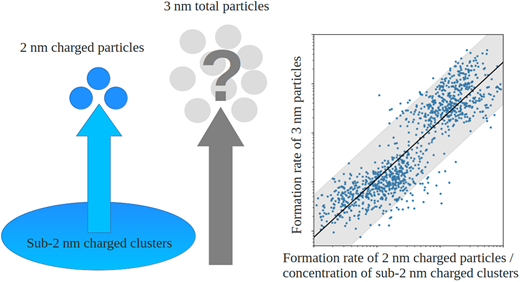
Estimation of atmospheric particle production based on measured ion concentrations

Santeri Tuovinen and Markku Kulmala et al.
Environ. Sci.: Atmos. (2026) 6 (8): 1178–1190, DOI: 10.1039/d6ea00045b

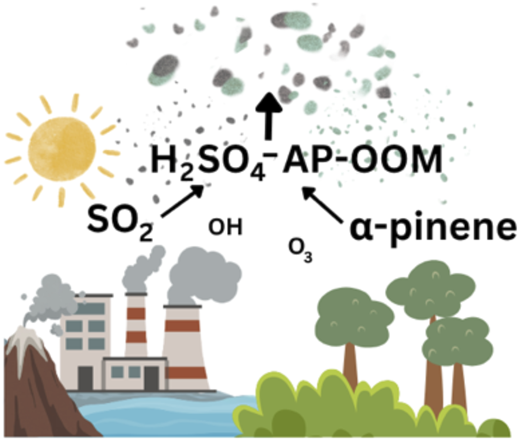
Nucleation of α-pinene oxidation products with sulfuric acid

Eva Sommer and Jasper Kirkby et al.
Environ. Sci.: Atmos.  (2026) 6 (8): 1131–1146, DOI: 10.1039/d6ea00046k

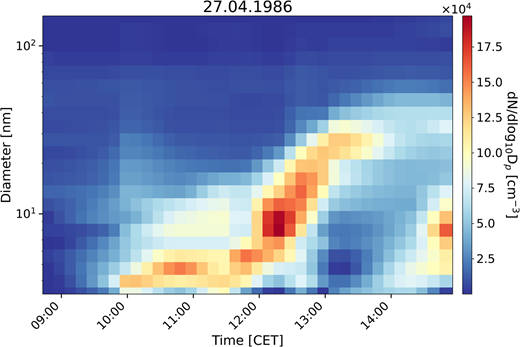
Reconstructed 40-year-old dataset of ultrafine particle concentrations in the urban background of Vienna, Austria compared to recent measurements – an investigation of long term air pollution evolution and dynamics

Aleksandra J. Morawiec and Paul M. Winkler et al.
Environ. Sci.: Atmos.  (2026) 6 (9): 1443–1452, DOI: 10.1039/d6ea00058d

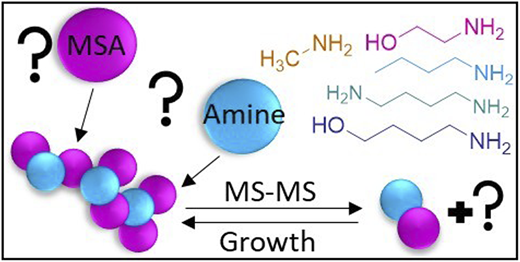
Chemically resolving the composition of methanesulfonic acid–amine nanoclusters

Colleen E. Miller, Ivo Neefjes, Yosef Knattrup, Paulus S. Bauer, Jonas Elm, Nanna Myllys*, Veronique Perraud*, James N. Smith*
Environ. Sci.: Atmos. (2026) 6 (9): 1386–1404, DOI: 10.1039/d6ea00060f

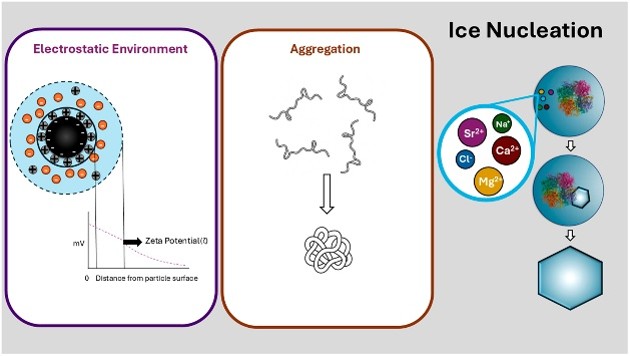
Promoting Ice Nucleation through Protein Aggregation and Electrostatic Environments

Roya Safa, Daniel C. O. Thornton, Sarah D. Brooks*.
Environ. Sci.: Atmos. (2026), Advance Article, DOI: 10.1039/d6ea00047a

Special themed collection dedicated to the 22nd International Conference on Nucleation and Atmospheric Aerosols (ICNAA)

The Editorial Office of Environmental Science: Atmospheres is excited to announce a special collection dedicated to the 22nd International Conference on Nucleation and Atmospheric Aerosols (ICNAA). This is the leading conference series in the wide field of nucleation and atmospheric aerosols.

We invite all researchers who will attend ICNAA 2025 to submit their papers for consideration in this special collection. It will encompass a broad range of topics, reflecting the diverse and cutting-edge research presented at the conference. The main topic areas of focus include:

Nucleation Theory & Experiment: Studies of homogeneous, heterogeneous and ion induced nucleation including single or multicomponent system cluster formation and properties, condensation, and evaporation, and experimental, theoretical and computational investigations as well as history of nucleation research.

Tropospheric & Stratospheric Aerosols: Fundamental processes associated with tropospheric and stratospheric aerosols, especially related to global warming, acid rain, air quality and multi-phase chemistry. Studies into aerosol concentrations and distributions, variability and long term trends. Focus on composition, hygroscopicity, thermodynamics, phase changes, physico-chemical and optical properties.

Cloud Drop and Ice Nucleation: Fundamental processes related to droplet and ice-crystal activation, growth, cloud condensation nuclei and ice nuclei origin, composition, spatial and temporal distributions and loadings, experimental and theoretical studies.

Aerosol-Climate Interactions: Direct and indirect effects of atmospheric aerosols on radiative forcing and climate, remote sensing and regional to global scale climate modelling of aerosol impacts and feedback systems.

This collection will be supported by our Guest Editors: Katrianne Lehtipalo, Zoran Ristovski, Neil Donahue and Paul Winkler. We look forward to your contributions to this themed collection, which will highlight the latest advancements and foster continued innovation in the field of atmospheric sciences. The submission deadline is December 31st 2025.

_ _ _ _ _ _ _ _ _ _ _ _ _ _ _ _ _ _ _ _ _ _ _ _ _ _ _ _ _ _ _ _ _ _ _ _ _ _ _ _ _ _ _ _ _ _ _ _ _ _ _ _ _ _ _ _ _ _ _ _ _ _

When you publish with Environmental Science: Atmospheres you can:

  • Put your trust in both our rigorous peer review process and fast times to publication – our average time to decision for peer-reviewed manuscripts is just 37 days.
  • Expect your work to be promoted through our journal social media (@envsci.rsc.org ‬and LinkedIn)
  • Be confident of a global audience for your work. This means that dissemination of this work will likely go beyond chemists and reach a broader audience.

Environmental Science: Atmospheres publishes high quality research in fundamental and applied atmospheric chemistry. The journal scope spans the entirety of Earth’s atmosphere, and studies addressing the interactions of indoor air pollutants with outdoor air, or considering human health effects, are encouraged. We offer authors the option to publish the peer review history alongside their article.

Article publication online and in issues will occur without delay to ensure the timely dissemination of the work. The articles will then be assembled on the RSC Publishing platform and promoted as a web-based thematic collection, to permit readers to consult and download individual contributions from the entire series.

If you’re interested, we invite you to submit your research today on our platform, quoting ‘EAICoNAA25’ in the ‘Comments to the Editor’ when submitting your manuscript. You can get in touch with the editorial office with any questions you may have about this collection.
Themed Collection Open Call: Solar Radiation Management

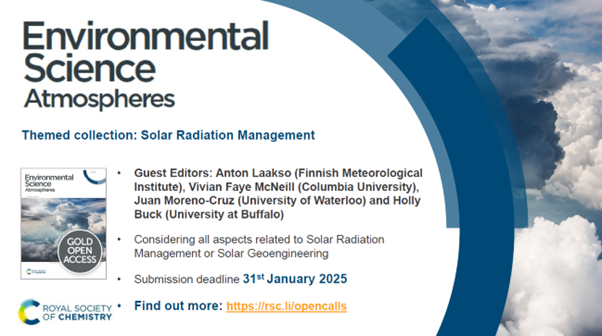
Submit your recent research on Solar Radiation Management to our new ES: Atmospheres collection! 

We invite you to contribute to our collection on Solar Radiation Management (SRM), also known as Solar Geoengineering. Understanding the mechanisms and potential impacts of SRM, as well as the broader field of solar geoengineering, can refine climate models, leading to more accurate projections of their efficacy and risks. SRM has the potential to reduce climate impacts globally, yet it also carries significant risks and uncertainties. For more information on the collection, which closes for submissions on 31 Jan 2025 , see our open call for papers.

When you publish with Environmental Science: Atmospheres you can:

  • Put your trust in both our rigorous peer review process and fast times to publication – our average time to decision for peer-reviewed manuscripts is just 38 days.
  • Expect your work to be promoted through our journal social media (@EnvSciRSC and LinkedIn)
  • Be confident of a global audience for your work. This means that dissemination of this work will likely go beyond chemists and reach a broader audience.

Environmental Science: Atmospheres publishes high quality research in fundamental and applied atmospheric chemistry. The journal scope spans the entirety of Earth’s atmosphere, and studies addressing the interactions of indoor air pollutants with outdoor air, or considering human health effects, are encouraged. We offer authors the option to publish the peer review history alongside their article.

Article publication online and in issues will occur without delay to ensure the timely dissemination of the work. The articles will then be assembled on the RSC Publishing platform and promoted as a web-based thematic collection, to permit readers to consult and download individual contributions from the entire series.

If you’re interested, we invite you to submit your research today, quoting ‘EASRM24’ in the ‘Comments to the Editor’ when submitting your manuscript. You can get in touch with the editorial office with any questions you may have about this collection.