


This year we are celebrating the 5th anniversary of Environmental Science: Atmospheres. To mark this occasion, we invited previous authors to contribute to an anniversary collection. The collection covers an exciting range of research in atmospheric science, from advances in analytical techniques for characterising atmospheric trace gases and aerosols to investigations of the impacts of human activities and wildfires on atmospheric composition and chemistry.
Please enjoy the articles in the collection below.
|
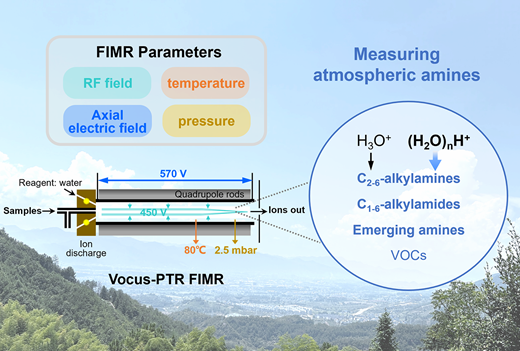
Optimizing Vocus proton-transfer-reaction mass spectrometry for detecting trace atmospheric amines Yiqi Zhao, Zhaojin An,* Yuyang Li, Rujing Yin, Dandan Li, Dongbin Wang, Xuan Zheng, Jun Zheng, Hong He, Jincai Zhao, Douglas R. Worsnop and Jingkun Jiang* Environ. Sci.: Atmos. (2026) 6 (6): 841–852 |
 |
|
|
Reduced U.S. methane emissions during the COVID-19 pandemic Sergio Ibarra-Espinosa,* Lei Hu, Colin Harkins, Brian C. McDonald, Scot M. Miller, Youmi Oh, Lori Bruhwiler, Colm Sweeney and Arlyn Andrews Environ. Sci.: Atmos. (2026) 6 (6): 831–840 |
|
|
|
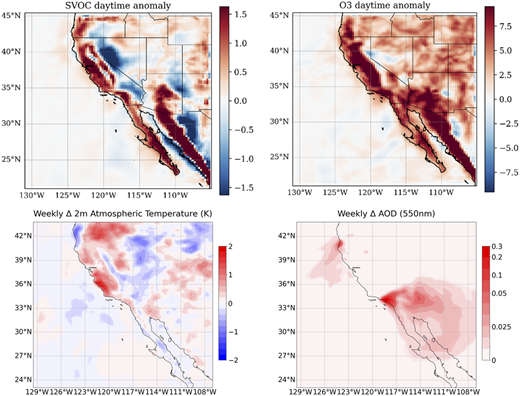
Eleni Dovrou,* Iulian-Alin Rosu and Apostolos Voulgarakis Environ. Sci.: Atmos. (2026) 6 (10): 1594–1603 |
 |
|
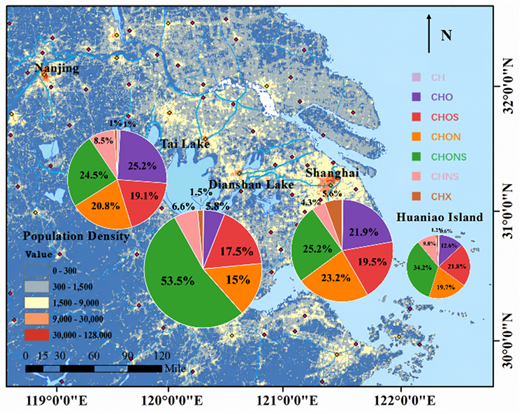
| Molecular characteristics of organic aerosols across typical environments in the Yangtze River Delta, China: insights from Orbitrap-MS analysis
Luoqi Lv, Cong An, Gan Yang, Chuang Li, Ning Wang, Jiayi Zhou, Kaiqi Lai, Qiaodi Lu, Runlong Cai, Lin Wang and Lei Yao Environ. Sci.: Atmos. (2026) 6 (10): 1617–1628 |
 |

As part of this series, we interviewed authors about their motivation and research goals.
| Dr Sergio Ibarra Espinosa (University of Maryland, and co-author of Reduced U.S. methane emissions during the COVID-19 pandemic) had this to say: | 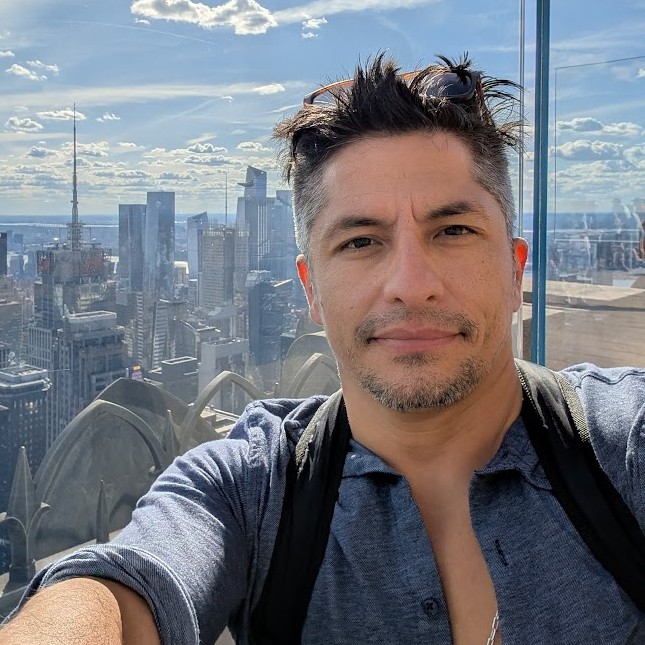 |
| 1. How has your research evolved from the first article you published with us, to your article investigating reduced U.S. methane emissions during the COVID-19 pandemic? Back in 2022, my first paper in the journal focused on how aerosols interact with meteorology in São Paulo across wet and dry seasons. Ironically, I’m back to looking at aerosol-climate interactions today, but now at a planetary scale with solar geoengineering! The common thread through all of this has been emissions modeling. My work evolved from building bottom-up urban emission inventories to tackling continental-scale top-down atmospheric inversions at NOAA GML. Setting up those inverse modeling and Kalman filter frameworks meant spending thousands of hours with HYSPLIT and writing open-source software like rtorf to parallelize and process footprint runs across North America. That experience directly opened the doors to my current work at NOAA ARL and CISESS developing hysplit-strato. The COVID-19 methane study was the culmination of that shift using 35 aircraft and tower sites to verify what happens to continental greenhouse gas fluxes when human activity abruptly shifts. 2. What aspect of your work are you most excited about at the moment? Going from local street-level problems to continental inversions, and now to global climate change and solar geoengineering. It’s pretty exciting to apply atmospheric modeling to questions that operate on a planetary scale, asking what happens when you intervene in the stratosphere and whether our global observing systems can even detect those signals. 3. In your opinion, what are the most important questions to be asked/answered in this field of research? 4. What do you find most challenging about your research? 5. How do you feel about Environmental Science: Atmospheres as a place to publish? 6. In which upcoming conferences or events may our readers meet you? 7. How do you spend your spare time? 8. Which profession would you choose if you were not a scientist? 9. Can you share one piece of career-related advice or wisdom with other atmospheric scientists? |
| Dr Eleni Dovrou (Assistant Professor at the University of Crete and co-author of Seasonal controls on wildfire-driven urban atmospheric chemistry: evidence from the January 2025 Los Angeles wildfires) had this to say: | 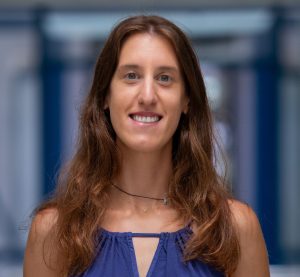 |
| 1. In your opinion, what are the most important questions to be asked/answered in this field of research?
I believe that the most important question is: what are the exact chemical pathways that determine the evolve of a fire plume and subsequently which chemical mechanisms influence environmental changes and human health in a molecular level? If we understand these mechanisms, we will be better able to identify the key processes driving these impacts and develop more effective strategies for protection and prevention. 2. How do you feel about Environmental Science: Atmospheres as a place to publish? Environmental Science: Atmospheres journal provides a great platform with a broad audience both within my field and across related fields. Thus, publishing in the journal offers strong visibility of our work while also helping connect new findings across disciplinaries. Although this was my first publication in the journal, I was satisfied and happy with the entire experience and the visibility the work has received. 3. Which profession would you choose if you were not a scientist? If I were not a scientist, I would probably be a professional volleyball player or a medical doctor or a student guidance counsellor or a bookstore owner. These choices might initially seem unrelated, but each represent an import part of my life. Volleyball is a sport I have played at a high level for the past 22 years; my interest in medicine developed during and after my scientific studies; helping students find their own path is something I already do regularly and genuinely enjoy; and I enjoy reading books and spending time in bookstores searching for my next read and discussing with other costumers. 4. Can you share one piece of career-related advice or wisdom with other atmospheric scientists? Take risks and try things that scare you the most. Remaining in your comfort zone will not help you grow. By choosing the path that feels intimidating, you may discover that you are far more capable than you thought, while opening yourself to new opportunities and experiences. And even if you fail, you will have learned something valuable and taken another step forward. Thank you again for this invitation and opportunity! |
|