Archive for July, 2022

New Themed Collection: “Indoor Air Quality” from ES: Atmospheres and ES: Processes & Impacts

Could our collection be the ideal platform for your next atmospheric and environmental science publication on indoor air quality?

We invite you to contribute to our growing collection highlighting the key role that the chemical sciences play in the study of indoor air quality, its interactions with outdoor air, health implications and exposure. For this collection, we invite submissions which focus on all aspects relating to indoor air quality, including theoretical and experimental methods, as well as modelling and consideration of policy and health impacts of indoor air quality. For more information on this cross-journal collection, which closes for submissions on 31st October, see open call for papers.

When you publish with Environmental Science: Atmospheres and Environmental Science: Processes and Impacts you can:

  • Put your trust in both our rigorous peer review process and fast times to publication – which are less than 9 weeks after submission across all our journals.
  • Expect your work to be promoted through our journal social media (@EnvSciRSC)
  • Be confident of a global audience for your work. As a leading voice in the chemical sciences, there are opportunities for work published in this collection to inform our policy positions on indoor air quality. This means that dissemination of this work will likely go beyond chemists and reach a broader audience.


Which journal should I choose?
Environmental Science: Atmospheres publishes high quality research in fundamental and applied atmospheric chemistry. The journal scope spans the entirety of Earth’s atmosphere, and studies addressing the interactions of indoor air pollutants with outdoor air, or considering human health effects, are encouraged. We offer authors the option to publish the peer review history alongside their article.

Environmental Science: Processes & Impacts publishes high quality articles in all areas of the environmental chemical sciences. The journal strongly prefers significant contributions whose results can be generalised to other systems, particularly those which characterise chemical processes or address contaminant environmental impacts. All authors have the option of double-anonymised peer review.

Article publication online and in issues will occur without delay to ensure the timely dissemination of the work. The articles will then be assembled on the RSC Publishing platform and promoted as a web-based thematic collection, to permit readers to consult and download individual contributions from the entire series.

If you’re interested, we invite you to submit your research today, quoting ‘XXIndAir22’ when submitting your manuscript.
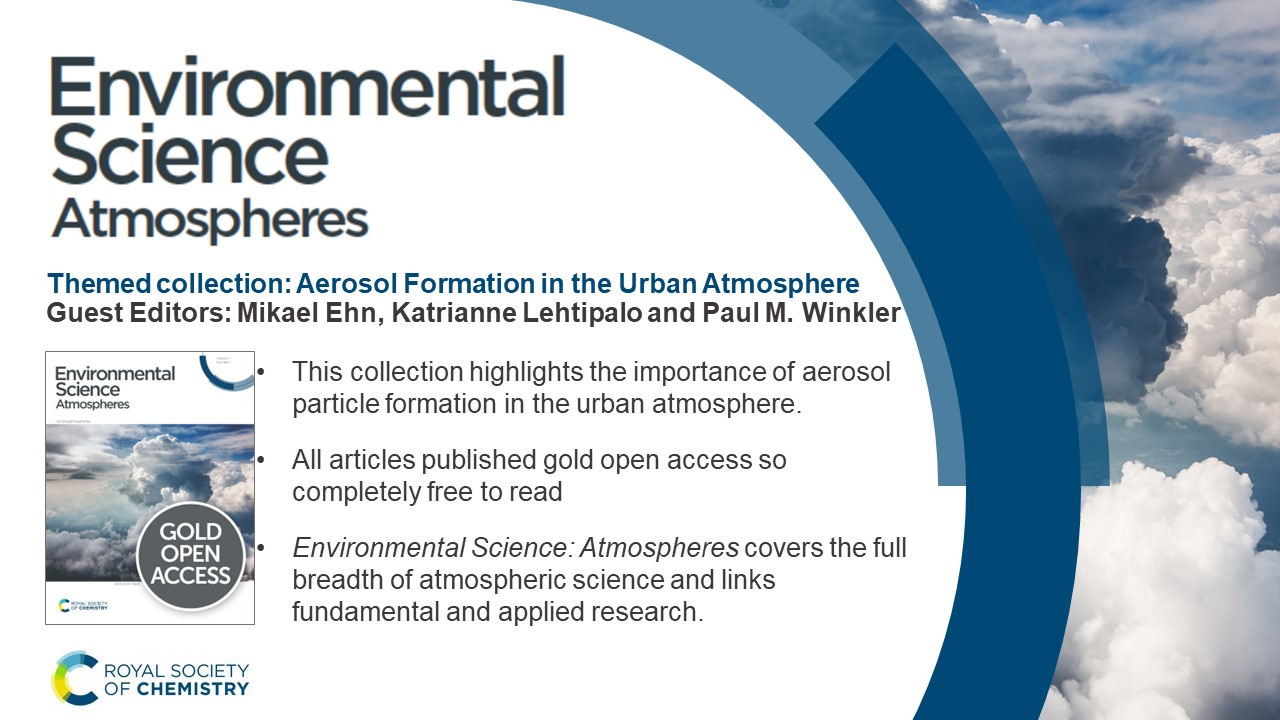
New themed collection ‘Aerosol formation in the urban environment’ from ES: Atmospheres now online

We are delighted to announce that the Environmental Science: Atmospheres themed issue ‘Aerosol formation in the urban environment’ is now online.

Guest Edited by Professor Mikael Ehn (University of Helsinki), Professor Katrianne Lehtipalo (University of Helsinki) and Professor Paul M. Winkler (University of Vienna), this collection includes studies on new particle formation and growth mechanisms and rates, and the sources, transformations and chemical composition of aerosol precursor vapours, clusters, and particles.

Read the full issue online.
It includes:

Paper
The contribution of new particle formation and subsequent growth to haze formation
Markku Kulmala, Runlong Cai, Dominik Stolzenburg, Ying Zhou, Lubna Dada, Yishuo Guo, Chao Yan, Tuukka Petäjä, Jingkun Jiang and Veli-Matti Kerminenbc
Environ. Sci.: Atmos., 2022, 2, 352-361. DOI: 10.1039/D1EA00096A

Paper
A computationally efficient model to represent the chemistry, thermodynamics, and microphysics of secondary organic aerosols (simpleSOM): model development and application to α-pinene SOA
Shantanu H. Jathar, Christopher D. Cappa, Yicong He, Jeffrey R. Pierce, Wayne Chuang, Kelsey R. Bilsback, John H. Seinfeld, Rahul A. Zaverie and Manish Shrivastavae
Environ. Sci.: Atmos., 2021, 1, 372-394. DOI: 10.1039/D1EA00014D

Paper
Observed coupling between air mass history, secondary growth of nucleation mode particles and aerosol pollution levels in Beijing
S. Hakala, V. Vakkari, F. Bianchi, L. Dada, C. Deng, K. R. Dällenbach, Y. Fu, J. Jiang, J. Kangasluoma, J. Kujansuu, Y. Liu, T. Petäjä, L. Wang, C. Yan, M. Kulmala and P. Paasonen
Environ. Sci.: Atmos., 2022, 2, 146-164. DOI: 10.1039/D1EA00089F

We hope you enjoy reading the articles!

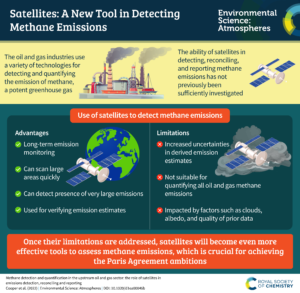
Research Infographic- Satellites: A New Tool in Detecting Methane Emissions

We are pleased to share this infographic on the use of satellites to detect and monitor methane emissions. A review on this topic was published in Issue 1 of Environmental Science: Atmospheres and can be read in full at Methane detection and quantification in the upstream oil and gas sector: the role of satellites in emissions detection, reconciling and reporting.

Jasmin Cooper, Luke Dubey and Adam Hawkes, Environ. Sci.: Atmos., 2022, 2, 9-23

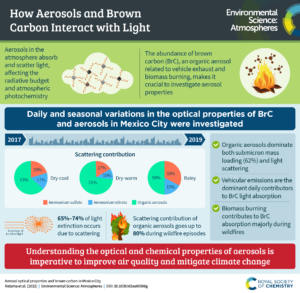
Research Infographic- How Aerosols and Brown Carbon Interact with Light

We are pleased to share this infographic on how brown carbon interacts with light. The study, which focuses on Mexico City, was published in Issue 3 of Environmental Science: Atmospheres, and can be read in full at: Aerosol optical properties and brown carbon in Mexico City

Armando Retama, Mariana Ramos-Cerón, Olivia Rivera-Hernández, George Allen and Erik Velasco, Environ. Sci.: Atmos., 2022, 2, 315-334