Archive for June, 2012

Top ten most accessed articles in May

This month sees the following articles in PPS that are in the top ten most accessed:-

Pathways of electron transfer photosensitized by thiacyanine dimers
A. K. Chibisov and G. V. Zakharova
Photochem. Photobiol. Sci., 2012,11, 893-897, DOI: 10.1039/C1PP05273J, Paper

Stem cell-based photodynamic therapy
Tej B. Shrestha, Gwi M. Seo, Matthew T. Basel, Mausam Kalita, Hongwang Wang, David Villanueva, Marla Pyle, Sivasai Balivada, Raja Shekar Rachakatla, Heather Shinogle, Prem S. Thapa, David Moore, Deryl L. Troyer and Stefan H. Bossmann
Photochem. Photobiol. Sci., 2012, Advance Article, DOI: 10.1039/C2PP05417E, Paper

ß-Cyclodextrin polymer nanoparticles as carriers for doxorubicin and artemisinin: a spectroscopic and photophysical study
Resmi Anand, Francesco Manoli, Ilse Manet, Samia Daoud-Mahammed, Valentina Agostoni, Ruxandra Gref and Sandra Monti
Photochem. Photobiol. Sci., 2012, Advance Article, DOI: 10.1039/C2PP25014D, Paper

On the genesis of heterogeneous photocatalysis: a brief historical perspective in the period 1910 to the mid-1980s
N. Serpone, A. V. Emeline, S. Horikoshi, V. N. Kuznetsov and V. K. Ryabchuk
Photochem. Photobiol. Sci., 2012, Advance Article, DOI: 10.1039/C2PP25026H

Controlled surface trap state photoluminescence from CdS QDs impregnated in poly(methyl methacrylate)
Santanu Karan, Manisree Majumder and Biswanath Mallik
Photochem. Photobiol. Sci., 2012, Advance Article, DOI: 10.1039/C2PP25023C, Paper

Photo-oxidation of proteins
David I. Pattison, Aldwin Suryo Rahmanto and Michael J. Davies
Photochem. Photobiol. Sci., 2011, Advance Article, DOI: 10.1039/C1PP05164D

Photoactivatable fluorophores and techniques for biological imaging applications
Wen-hong Li and Genhua Zheng
Photochem. Photobiol. Sci., 2012, Advance Article, DOI: 10.1039/C2PP05342J

On the singlet states of porphyrins, chlorins and bacteriochlorins and their ability to harvest red/infrared light
Carlos J. P. Monteiro, J. Pina, Mariette M. Pereira and Luis G. Arnaut
Photochem. Photobiol. Sci., 2012, Advance Article, DOI: 10.1039/C2PP25021G, Paper

UV wavelength-dependent DNA damage and human non-melanoma and melanoma skin cancer
Gerd P. Pfeifer and Ahmad Besaratinia
Photochem. Photobiol. Sci., 2012,11, 90-97, DOI: 10.1039/C1PP05144J

Applications of p-hydroxyphenacyl (pHP) and coumarin-4-ylmethyl photoremovable protecting groups
Richard S. Givens, Marina Rubina and Jakob Wirz
Photochem. Photobiol. Sci., 2012, 11, 472-488, DOI: 10.1039/C2PP05399C

Why not take a look at the articles today and blog your thoughts and comments below.

Fancy submitting an article to PPS? Then why not submit to us today or alternatively email us your suggestions.

Digg This
Reddit This
Stumble Now!
Share on Facebook
Bookmark this on Delicious
Share on LinkedIn
Bookmark this on Technorati
Post on Twitter
Google Buzz (aka. Google Reader)

PPS Issue 7 now online!

The latest issue of PPS is now available online!

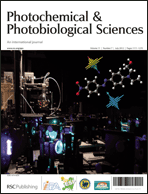
The front cover of this issue features work by Falk Renth, Friedrich Temps and colleagues from the University of Kiel, Germany, who report the sequential photoisomerisation dynamics of the push-pull azobenzene Disperse Red 1.  Azobenzene forms the basis of a number of numerous derivatives with applications as photochromic switches, tiny light-driven molecular manipulators, actuators and engines, and small optical memory or logical devices.  However, to reach the ambitious applications and designs for optimised functional azobenzene devices, we need to have detailed knowledge of the molecular dynamics of these molecules under different conditions. 

Here the team looked at substituted azobenzene dye Dispersed Red 1 (DR1), which is an electron donor-electron acceptor dye and a so-called push-pull azobenzene.  The donor-acceptor substitution introduces a strong charge-transfer character to the ππ* electronic transition.  The authors studied the ultra-fast dynamics of this push-pull character after photoexcitation at λpump= 475 nm by femtosecond time-resolved transient absorption spectroscopy and fluorescence up-conversion spectroscopy. This study of the DR1 dye in solution has provided a basis for the interpretation of new experiments on the photodynamics of DR1 in complex environments and under application-relevant conditions.

This article is free to access for 6 weeks!  Click on the link below to find out more…

Sequential photoisomerisation dynamics of the push–pull azobenzene Disperse Red 1, Julia Bahrenburg, Katharina Röttger, Ron Siewertsen, Falk Renth and Friedrich Temps, Photochem. Photobiol. Sci., 2012, 11, 1210-1219 DOI: 10.1039/C2PP05400K

You can keep up to date with the latest developments from PPS by signing up for free table of contents alerts.

Digg This
Reddit This
Stumble Now!
Share on Facebook
Bookmark this on Delicious
Share on LinkedIn
Bookmark this on Technorati
Post on Twitter
Google Buzz (aka. Google Reader)

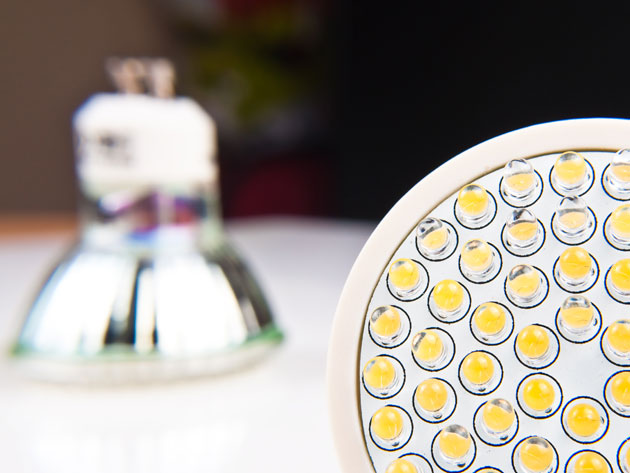
Which energy saving light bulb is best for sensitive skin?

LED lightbulb shutterstock

LEDs may provide a safe alternative for photosensitive individuals

UK researchers have compared the UV emissions given off by different types of energy saving light bulbs so that people with photosensitive skin can reduce their exposure to UV light. The team found that LED lamps give off the lowest UV levels.

The European Union has legislated that traditional incandescent bulbs should be phased out by the end of 2012 to be replaced by energy saving alternatives. All bulbs produce some UV light and there are guidelines on exposure limits for healthy individuals. However, no limits have been set for people with photosensitive skin conditions.

This lack of data inspired Leona Fenton and her colleagues from the University of Dundee to analyse the UV emissions from different types of energy saving light bulbs. ‘Many individuals are stockpiling incandescent lamps due to worry over there being no alternative that will not put their skin at risk,’ says Fenton.

Read the full article in Chemistry World

Link to journal article
Analysis of energy saving lamps for use by photosensitive individuals

L. Fenton, J. Ferguson and H. Moseley
Photochem. Photobiol. Sci.,
2012, Advance Article, DOI: 10.1039/C2PP25035G, Paper

Digg This
Reddit This
Stumble Now!
Share on Facebook
Bookmark this on Delicious
Share on LinkedIn
Bookmark this on Technorati
Post on Twitter
Google Buzz (aka. Google Reader)