



To celebrate the growth and development of the RSC Applied Polymers community and to highlight the remarkable authors who continue to contribute their high quality work to the journal, we would like to share the opinions and insights of these authors through this introductory blog post. Once dubbed #RSCAppliedfirst50, our blog posts aim to give a voice to the authors behind the research and hope that their insights might shed light upon growing challenges and progress in polymer science and its applications.
In this edition, we hear from Aditi Jain, Mahesh Dhonde, Ankit Soni and Ashok Kumar as they discuss their recently published article, ‘Toward application-ready biodegradable shape-memory polymer composites: mechanisms, trade-offs, and design rules‘.
An introduction from the authors
Shape-memory polymers can hold a temporary shape and return to their original form on cue, which makes them useful for stents, deployable devices, smart packaging, and soft grippers. Most commercial grades, however, are petroleum-based and stay in the body or the environment long after their job is done. Biodegradable versions based on PLA, PCL, PBS, PVA, chitosan, gelatin, cellulose, or starch offer a way out, yet few have moved beyond laboratory demonstrations.
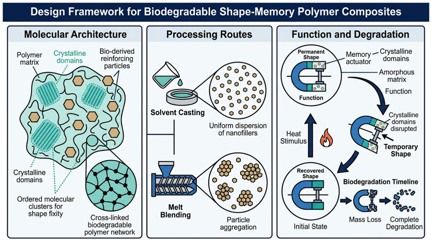
Figure 1. Graphical abstract: design framework linking molecular architecture, processing route, and function and degradation in biodegradable shape-memory polymer composites. From Jain et al., RSC Appl. Polym., 2026, DOI: 10.1039/d6lp00252h.
The reason is rarely a single weak property. PLA fixes shapes well but is brittle. PCL switches near body temperature but is soft and can take years to degrade. Hydrophilic matrices absorb moisture and may recover before they are ever used. Most importantly, degradation erodes the very parameters that drive actuation, yet fixity and recovery are usually measured only on fresh samples. Reported values are also hard to compare, because programming conditions, recovery modes, and degradation protocols differ from study to study. We therefore propose a minimum reporting checklist to put results on a common footing.
The review follows the designer’s path from matrix to reinforcement, processing, and application, and links each material property to the shape-memory indicator it controls. Nanocellulose and lignin add stiffness at low environmental cost. Carbon nanotubes, graphene, and polypyrrole enable fast, remote actuation but lose recoverable strain when overloaded. There is also a point the field often overlooks: a persistent nanofiller in a degradable matrix does not make the composite biodegradable.
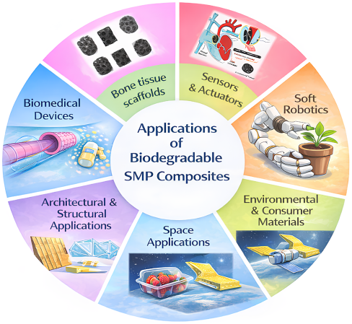
Figure 2. Application areas of biodegradable shape-memory polymer composites. Adapted from Fig. 6 of Jain et al., RSC Appl. Polym., 2026, DOI: 10.1039/d6lp00252h (CC BY-NC 4.0).
From this analysis, we derive application-specific design rules. The most mature uses are those where transience is the point, such as resorbable stents, self-fitting scaffolds, and gastrointestinal devices that unfold at body temperature and then dissolve. Packaging, agricultural films, and disposable sensors follow, while soft robotics and deployable structures remain limited by slow actuation and modest recovery force.
Our central message is that “biodegradable” describes an environment, not a material. PLA composts within months at 55–60 °C but barely degrades in seawater. Credible design begins by naming where the device will end its life.
Meet the authors
 |
Dr Aditi Jain is an Assistant Professor at the Department of Physics at Medicaps University, Indore, specializing in polymer physics and functional materials. Her research focuses on the synthesis, characterization, and structure–property investigation of conducting polymer composites, shape memory and stimuli-responsive polymers, polyaniline–cellulose nanofiber systems, polymer blends, and pulsed laser deposited thin films. Her work integrates spectroscopic and thermal characterization, morphological analysis, and materials engineering to correlate the microstructure with the functional response in sensing and energy-related materials. She has published research articles in peer-reviewed international journals, holds an Indian patent, and actively guides undergraduate and postgraduate students. Her current interests include shape memory polymer actuation, gas sensing, and multifunctional polymer composites.
|
 |
Dr Mahesh Dhonde serves as an Assistant Professor at the Department of Physics at Medicaps University, Indore. He works in the area of solar energy materials and nanoscale functional systems, with research directed towards dye-sensitized and thin-film photovoltaic devices, silicon-based solar cells, indoor light-harvesting technologies, semiconductor nanomaterials, and photonic metasurface structures. Employing a combination of chemical synthesis routes, optoelectronic measurements, and device-level optimization, he examines how charge transport and light management govern photovoltaic performance. Alongside a record of publications in reputed international journals, he mentors undergraduate and postgraduate students in laboratory research. Indoor photovoltaics, dielectric metasurfaces, and emerging solar cell architectures form his ongoing areas of interest.
|
 |
Dr Ankit Soni is an Assistant Professor at the Department of Physics at Medicaps University, Indore. He received his Ph.D. in Physics from IIT Indore and subsequently worked as a Project Scientist at IIT Delhi and a National Postdoctoral Fellow at IISER Bhopal. His research focuses on thin films, nanostructures, functional oxide materials, pulsed laser deposition, photodetectors, and condensed matter physics. He has published several research articles in reputed international journals and serves as a reviewer for leading publishers, including IOP Publishing, Springer Nature, Elsevier, IEEE, etc.
|
 |
Dr Ashok Kumar is an Assistant Professor at the Department of Physics, specializing in condensed matter physics and functional materials. His research focuses on the synthesis, characterization, and theoretical investigation of perovskite and anti-perovskite oxides, rare-earth cobaltites, thin films, nanostructured materials, and magnetoelectric phenomena. His work integrates advanced spectroscopic techniques, computational modelling, and materials engineering to understand structure–property relationships in energy and electronic materials. He has published research articles in peer-reviewed international journals and actively supervises undergraduate and postgraduate research. His current interests include correlated electron systems, spintronic materials, and multifunctional oxides.
|
Toward application-ready biodegradable shape-memory polymer composites: mechanisms, trade-offs, and design rules
Aditi Jain; Mahesh Dhonde; Ankit Soni; Ashok Kumar; Kavita Soni; Kirti Sahu; Disha Harinkhere; Shalini Mishra
RSC Appl. Polym. (2026). DOI: 10.1039/d6lp00252h

 |
RSC Applied Polymers is a leading international journal for the application of polymers, including experimental and computational studies on both natural and synthetic systems. In this journal, you can discover cross-disciplinary scientific research that leverages polymeric materials in a range of applications. This includes high impact advances made possible with polymers across materials, biology, energy applications and beyond. |