New Platform Release – Multiple Downloader Tool

The latest updates to the RSC Publishing Platform have now gone live today including the Download Selected Files tool – an option on the Journal Issues tab allowing you to download multiple articles or a whole issue in just a couple of clicks.

Mulitple Downloader Tool

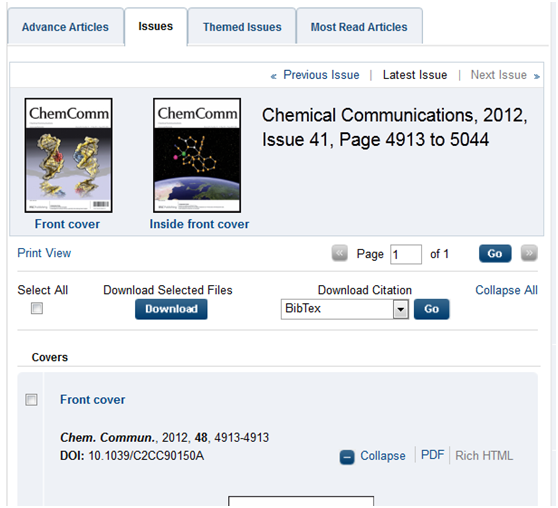
Each article has a tick box next to the article title, clicking the box selects the article. You can select a number of articles, or simply select the whole issue using the ‘Select All’ button.

Clicking the ‘Download’ button will open a separate window, you will then be prompted to run a Java applet which will load up the Multiple File downloader. To start the download you must first select a folder location. Once a folder is selected the applet window will automatically start downloading your selected articles. When all of the files have downloaded, simply close the applet window.

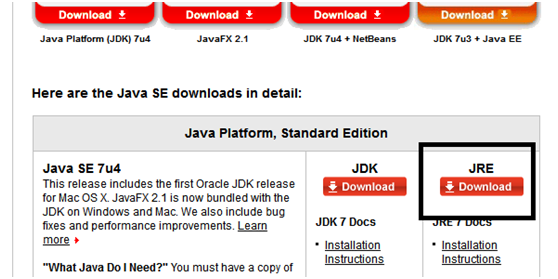
The Multiple Downloader tool runs on Java, and as a result you may initially be prompted to download the latest Java Runtime Environment (JRE). You can download the most up-to-date Runtime Environment which can be found on the Oracle.com website
GO TO http://www.oracle.com/technetwork/java/javase/downloads/index.html 

Updating Java

We plan to incorporate the Multiple Download button to other tabs and pages in addition to the Journal Issues tab in the near future. In the meantime we would welcome any comments or suggestions regarding the applet.

If you would like any additional support or feedback your suggestions, please contact Technical Support and we will happily help
EMAIL technicalsupport@rsc.org

Digg This
Reddit This
Stumble Now!
Share on Facebook
Bookmark this on Delicious
Share on LinkedIn
Bookmark this on Technorati
Post on Twitter
Google Buzz (aka. Google Reader)

New Platform Release – with Patents returned from SureChemOpen

We have now gone live with the latest version of the RSC Publishing Platform with two new exciting additions to the functionality.

SureChemOpen Patent Linking

A selection of articles on the RSC Publishing Platform have a compound tab on the article landing page (we are actively working to increase the number of articles that have this feature). For those articles with a compound tab, you are able to link through to ChemSpider, and we have now added direct links to SureChemOpen, a suite of patent chemistry data. More information on this exciting development can be found on the ChemSpider blog post about the partnership with SureChemOpen.

Book Searching

We have now made it easier to search our ebook collection by offering a search box directly on the ebook landing page, and allowing you to browse the collection by ebook collection year – allowing you to see which books are available for different ebook years.

There is also much work going on behind the scenes: for our IOS app we will shortly be adding eBooks to the functionality, we’re working on author reprint functionality, and some other exciting developments that we will be able to share with you soon.

Digg This
Reddit This
Stumble Now!
Share on Facebook
Bookmark this on Delicious
Share on LinkedIn
Bookmark this on Technorati
Post on Twitter
Google Buzz (aka. Google Reader)

RSC Publishing content is more discoverable

New agreements with Serials Solution Summon™, EBSCO Discovery Service™, ProQuest Illustrata™ and OCLC Worldcat.

RSC Publishing is pleased to announce new agreements for our content to be indexed in Serials Solution Summon™, EBSCO Discovery Service™, ProQuest Illustrata™ and OCLC Worldcat, aligned with our key priorities for discoverability of content.

RSC Publishing is taking major steps in partnering with third party solutions to make our content more discoverable. We have seen significant growth in high quality content – over 150% in the last three years and an average increase of 26% for content usage in 2011. 

To accommodate this growth,  we have made considerable technical advancements in the last few years including the new RSC Publishing Platform to help users search content, our award winning semantic technology and developments to ChemSpider (our free chemical database). Working with these third parties on the discoverability of content, helps us maintain the level of standard that our customers and users expect in accessing this high impact scientific content.

Stephen Hawthorne says, “RSC is fully committed to meeting the needs of our customers.  By supporting these discovery solutions and integrating RSC content into their service of choice, we are ensuring researchers, faculty and students can effectively reach our world-class scientific content“.

We will be announcing more agreements in 2012, sign up to the RSC Publishing Innovation blog RSS feed to receive the latest developments.

For any technical queries, please
EMAIL technicalsupport@rsc.org

Digg This
Reddit This
Stumble Now!
Share on Facebook
Bookmark this on Delicious
Share on LinkedIn
Bookmark this on Technorati
Post on Twitter
Google Buzz (aka. Google Reader)

RSC Publishing Platform Update January 2012

The latest update is now live on the RSC Publishing Platform including improved meta-data for Google Scholar discoverability, author affiliation information, other author/article content of relevance, Full Text Access visual and RSC Open Science

RSC Publishing is pleased to announce that the latest update of the RSC Publishing Platform is now live after continued feedback from the scientific community. 

As well as improved meta-data on article pages to increase our discoverability in Google Scholar, other developments include:

Author Affiliations

Can now be viewed from the article landing pages – just hover over an author’s name to see the pop up window.

Please note not available for Advance Articles and Accepted Manuscripts.

      Author Affiliation on the RSC Publishing Platform

More content by authors or articles

View more content by authors or articles by selecting the authors name on the right hand side.

  Author Filter on the RSC Publishing Platform

Check Full Text Access

After performing a search, check which articles you have full text access to using a ‘Check Access’ button.

Please note that this may take a moment to complete this process.

  Full Text Access on the RSC Publishing Platform

RSC Open Science

RSC Open Science articles are labelled on the article landing page.

  RSC Open Science on the RSC Publishing Platform

If you have any technical queries, please
EMAIL technicalsupport@rsc.org

Digg This
Reddit This
Stumble Now!
Share on Facebook
Bookmark this on Delicious
Share on LinkedIn
Bookmark this on Technorati
Post on Twitter
Google Buzz (aka. Google Reader)

RSC Mobile Android Version Now Available

Access the most relevant scientific research with this free RSC Mobile app available on iTunes and in the Android Market


RSC Mobile AppRSC Publishing is pleased to announce after the success of the free RSC Mobile app for iOS, we have now launched the free Android version.  Released ahead of schedule in December 2011, the Android version was sent to users who expressed an interest in trialling the app and providing feedback for any further developments. 

This has now been completed and we can now officially launch the app to the marketplace.

For more information on RSC Mobile
GO TO www.rsc.org/rscmobile

or to download click on the logos below:

Android Market App RSC Mobile app available on iTunes

If you are interested in helping RSC Publishing with future developments, have any feedback or require technical assistance, please
EMAIL technicalsupport@rsc.org

What is RSC Mobile?

RSC Mobile provides readers with access to search more than 30 RSC journals from our RSC Publishing Platform.

If your institution/organisation pays for RSC journals, then you can access exactly the same content on this app using your institutions/organisations wireless network.

RSC Mobile includes:

  • Up-to-the-minute access to RSC journals 
  • Full text HTML and PDF access via wireless networks for subscribing institutions/organisations 
  • The latest news from our RSC Publishing Platform 
  • Saving articles for offline reading 
  • Share your favourite content via email, Twitter or Facebook    

For more information on the RSC Mobile app and to download on iTunes or Android Market
GO TO www.rsc.org/rscmobile

Martin Resano Ezcaray, University of Zaragoza, Spain

“Great app! It makes it dead simple to be up-to-date with your research areas of interest.
Easy to use, very flexible search, permits direct off-line saving of abstracts or papers, plus sharing your results with your colleagues (via e-mail, Facebook or Twitter) is just one-button away.
A must for any chemist!”

Martín Resano Ezcaray, University of Zaragoza, Spain

Sign up to the RSC Publishing Innovation RSS feed to keep up-to-date with future developments.

You may also find of interest the new free ChemSpider app which is available on iTunes

Digg This
Reddit This
Stumble Now!
Share on Facebook
Bookmark this on Delicious
Share on LinkedIn
Bookmark this on Technorati
Post on Twitter
Google Buzz (aka. Google Reader)

RSC Publishing Platform Maintenance

RSC Publishing Platform Update

RSC Publishing would like to give advanced notice that the RSC Publishing Platform will be subject to maintenance at 00.00am GMT on Saturday 14th January 2012 to 00.00am Monday 16th January 2012, which may affect performance and accessibility of content.

This is essential maintenance required for the backend systems behind the RSC Publishing Platform and should not result in downtime but the Platform may perform slower than usual during this period.  This time has been selected as it is when there is least usage on the Platform, please accept our apologies for any inconvenience this may cause.

For a full list of time zones when the RSC Publishing Platform is subject to this maintenance, please see below:

Time Zone
RSC Publishing Platform Downtime on Saturday 14th January 2012 to Monday 16th January 2012 GMT
Australian Eastern Standard Time (EST) 10.00am Saturday 14th January 2012 to 10.00am Monday 16th January 2012
Brazilian Standard Time (BRT) 21.00pm Friday 13th January 2012 to 21.00pm Sunday 15th January 2012
Greenwich Mean Time (GMT) 00.00am Saturday 14th January 2012 to 00.00am Monday 16th January 2012
Central European Time (CET) 01.00am Saturday 14th January 2012 to 01.00am Monday 16th January 2012 
Eastern Standard Time (EST) 19.00pm Friday 13th January 2012 to 19.00pm Sunday 15th January 2012
Japanese/Korean Standard Time (JST/KST) 09.00am Saturday 14th January 2012 to 09.00am Monday 16th January 2012
Malaysian/Chinese Standard Time (MYT/CST) 08.00am Saturday 14th January 2012 to 08.00am Monday 16th January 2012
New Zealand Daylight Saving Time (NZDT) 13.00pm Saturday 14th January 2012 to 13.00pm Monday 16th January 2012
Western European Time (WET) 00.00am Saturday 14th January 2012 to 00.00am Monday 16th January 2012

If you have any technical queries, please
EMAIL technicalsupport@rsc.org

RSC Mobile App
The new RSC Mobile app is now available in the Android Market as well as on iTunes
GO TO http://blogs.rsc.org/technical/2012/01/11/rsc-mobile-android/

or click on the logos below:

Android Market App RSC Mobile app available on iTunes

RSC Publishing

Digg This
Reddit This
Stumble Now!
Share on Facebook
Bookmark this on Delicious
Share on LinkedIn
Bookmark this on Technorati
Post on Twitter
Google Buzz (aka. Google Reader)

RSC Publishing supports Japanese Shibboleth

RSC Publishing is pleased to announce that it is developing the RSC Publishing Platform to work with Shibboleth institutions all over the world giving customers and users more access to high impact scientific content.

Already compliant with UK Access Management Federation, RSC Publishing is now meeting the requirements of the Japanese Federation GakuNin for their Shibboleth compliance.  GakuNin member institutions can now access content they subscribe to with their GakuNin username and password whether on or off campus.

Shibboleth offers federated identity-based authentication and authorisation which allows one security domain to be shared with the users of that federation, enabling members to have single sign on and removing the need for multiple usernames and passwords. It is a well used project all over the world with academic institutions.

Stephen Hawthorne, Sales Director at RSC Publishing says, “The RSC fully supports easing access to quality content for researchers worldwide and implementation of the Japanese Federation GakuNin for Shibboleth is the next step in our strategy to achieve this.”

As well as working towards global Shibboleth compliance, RSC Publishing high impact content is still accessed through registered IP addresses and Athens. For any technical queries, please
EMAIL technicalsupport@rsc.org

Digg This
Reddit This
Stumble Now!
Share on Facebook
Bookmark this on Delicious
Share on LinkedIn
Bookmark this on Technorati
Post on Twitter
Google Buzz (aka. Google Reader)

ChemSpider plugin for IDBS ELN

By daya.

The functionality of electronic lab notebooks (ELNs) and that of ChemSpider overlap to a certain extent – both store chemical information including structures, data, spectra and reactions. However, the focus of most ELNs is to manage, track and audit that data, and that of ChemSpider is to publish and disseminate it to the world. We have been considering how best to use this complementary functionality to integrate an ELN with ChemSpider.

At the meeting “The Smart Laboratory: Towards a national ELN” meeting (organised as part of the Dial-a-Molecule EPSRC Grand Challenge) in August this year, the seeds were sown to do this. Cambridge University has the first Chemistry department in the UK to roll out a department-wide Electronic Lab notebook system, and the software that they’re using is IDBS’s E-WorkBook Suite. In collaboration with IDBS and Cambridge’s Chemistry department, we at ChemSpider have made a plug-in which could both dynamically retrieve information from ChemSpider into their ELN, and publish to it the other way. The Chemistry department at Cambridge (Dr Tim Dickens, Dr Brian Brooks, Prof Bobby Glenn and Prof Steven Ley) have been very helpful in granting access to their ELN to write the plug-in, and will be its first users, but the results will be freely available for any existing IDBS E-WorkBook suite user.

About the extension Prof Bobby Glenn has said: “Much of Chemistry is lost, it is simply not published and languishes in forgotten lab notebooks. Capturing novel molecules soon after synthesis on a searchable database like Chemspider is now an effortless process directly from the ELN, which will greatly encourage sharing of compounds, synthetic methods and all the associated data. It’s instant messaging for chemists”. Antony Williams (Vice-President of Strategic Development of ChemSpider) added “The ability to now publish compound data from the IDBS ELN directly to ChemSpider offers a path to direct exposure of novel chemistry as well as the chemist doing the work. This public compound registration capability is the first move towards ultimately exposing synthetic methods and associated experimental data to the community. Our vision is coming to fruition through this collaboration.”

To view the plug-in in action please view the demonstration movie of ChemSpider E-WorkBook Suite Plugin.

Screen capture of launching Publish to ChemSpider plug-in

Compounds can be published to ChemSpider if they have been drawn out in full in an experiment – whether this is as an individual structure or part of a reaction, and whether they are simply uploaded into the experiment as a reaction file, or included in for example a spreadsheet item. Likewise, compound structures can be automatically loaded into a search of ChemSpider if you would like to find out more information about compounds that have been drawn out in full in an experiment, or if you have published a compound to ChemSpider and wish to see the resulting compound pages. The resulting compound pages in ChemSpider will have the data source “IDBS E-WorkBook Suite”. The external ID will show the ID of the experiment from which the structures are from, and the depositor details as defined in the ChemSpider Settings of the ELN.

The ChemSpider IDBS E-WorkBook Suite plug-in is freely available to customers of IDBS E-WorkBook Suite by downloading it from IDBS, and copying it the appropriate place in their IDBS E-WorkBook Suite program files. It is compatible with E-WorkBook Suite versions 9.0 and 9.1.

This plug-in is an initial proof-of-concept to demonstrate that we can pass compound information between ChemSpider and an ELN in both directions. Future versions will allow more of the information within an experiment to be published to ChemSpider – for example to allow reactions along with a description of their methods to be published to ChemSpider SyntheticPages, or to deposit spectra along with compounds to ChemSpider. We would also like to integrate other ELNs with ChemSpider.

Digg This
Reddit This
Stumble Now!
Share on Facebook
Bookmark this on Delicious
Share on LinkedIn
Bookmark this on Technorati
Post on Twitter
Google Buzz (aka. Google Reader)

New RSC Publishing Platform release

We have now gone live with our latest RSC Publishing Platform release, which contains several new features to improve your experience:

  • Open Science articles are now available without the need to login to your RSC Publishing personal account or authenticating through your institution/organisation
  • Clearer links to allow you to subscribe to our journal Twitter feeds or TOC e-alerts
  • Next and Previous buttons for articles added to the full text HTML page
  • Google +1 and Twitter shortcuts added allowing you to share articles
  • Easier Browse by functionality with the first two fields prepopulated with the current decade and volume
  • When typing a search term into the search box that is an existing journal name, this used to take you straight to the journal.  Users have fed back that they use generic terms like green chemistry and want to see article results and not be taken to the journal home page.  This has now been changed and if relevant, the journal is highlighted above the search results. We are working to improve this functionality further
  • Chemistry Education Research in Practice (CERP) from 2005 to 2007 is now available on the Platform.

We have also continued to work closely with our technical team to ensure we maintain maximum availability and fast performance. We are also expanding the infrastructure behind the Platform to host the increasing number of articles we have available.

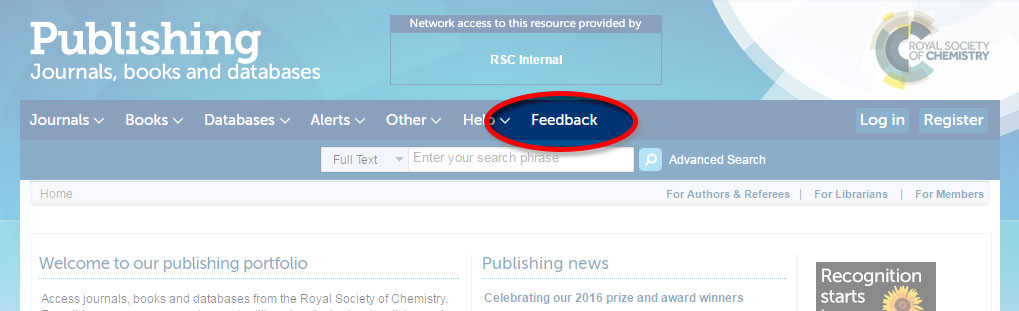
We hope you enjoy the additional features and please do let us know your views on the RSC Publishing Platform by adding your comments to the Feedback link available on the top right of every page on the RSC Publishing Platform

For any technical queries, please contact technicalsupport@rsc.org

Digg This
Reddit This
Stumble Now!
Share on Facebook
Bookmark this on Delicious
Share on LinkedIn
Bookmark this on Technorati
Post on Twitter
Google Buzz (aka. Google Reader)

Chemistry Education Research and Practice 2005 – 2007

Chemistry Education Research and Practice (CERP) is the RSC’s open access journal for researchers and practitioners at all levels of chemistry education.

Issues from 2005-2007 are not yet available on our RSC Publishing Platform, however we are currently working to ensure this content is added shortly. 

To access this content now
GO TO http://www.rsc.org/Publishing/Journals/RP/issues/

Digg This
Reddit This
Stumble Now!
Share on Facebook
Bookmark this on Delicious
Share on LinkedIn
Bookmark this on Technorati
Post on Twitter
Google Buzz (aka. Google Reader)