Author Archive

Paper of the week: Facile synthesis of chain-end multifunctional polymers

Chain-end functionalization of synthetic polymers is an established route to functional soft materials and the resulting end-functionalized polymers are useful in many applications. However, current synthetic approaches that do not involve functional group transformations and protection/deprotection protocols are limited to installation of a single type of functionality at the polymer chain-end. This needs to be addressed as chemically heterogeneous multifunctionalization is expected to increase the range of possible applications as well as performance of the functionalized materials

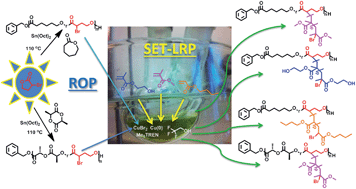
Graphical abstract: Protecting-group-free synthesis of chain-end multifunctional polymers by combining ATRP with thiol–epoxy ‘click’ chemistry

In this context, by combining atom-transfer radical polymerization (ATRP) with thiol–epoxy‘click’ chemistry, Khan and co-workers described a general and effient synthetic scheme, free from the usual protection/deprotection requirement of organic synthesis, for installation of two different types of functional groups at a polymer chainend. This strategy also allowed for total control over the number of the chain-end functionalities. In essence, the present strategy established a novel, modular and efficient route to chain-end multifunctional polymers with chemically complex yet molecularly precise structures and is expected to impact the current design of functional soft materials targeted for sophisticated applications.

Protecting-group-free synthesis of chain-end multifunctional polymers by combining ATRP with thiol–epoxy ‘click’ chemistry by Ikhlas Gadwal and Anzar Khan, Polym. Chem., 2013, 4, 2440-2444.

Julien Nicolas is a guest web-writer for Polymer Chemistry. He currently works at Univ. Paris-Sud (FR) as a CNRS researcher.

Digg This
Reddit This
Stumble Now!
Share on Facebook
Bookmark this on Delicious
Share on LinkedIn
Bookmark this on Technorati
Post on Twitter
Google Buzz (aka. Google Reader)

Paper of the week: mesoporous poly(ionic liquid) complexes

Polymerized ionic liquids or poly(ionic liquid)s (PILs), which are usually synthesized by polymerization of ionic liquid (IL) monomers, constitute a subclass of polyelectrolytes that combine some IL properties with the common features of polymers. Porous PILs possess increased surface area and can accelerate the interfacial mass and energy exchange, thus are important in some fields, for instance catalysis or fast stimuli-responsive materials. Very recently, it has been shown that ionic complexation between cationic PILs and deprotonated poly(acrylic acid) could create a micro/mesoporous matrix without using a template.

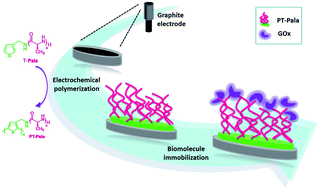
Graphical abstract: Organic acids can crosslink poly(ionic liquid)s into mesoporous polyelectrolyte complexes

In this communication, Yuan and co-workers prepared mesoporous polyelectrolyte networks through the ionic complexation between imidazolium-based cationic PILs and organic oligoacids in ammonia-containing diethyl ether. The as-synthesized porous networks exhibited good structural stability and large specific surface area up to 290 m2 g-1. This unique template-free strategy is very simple in operation and was shown to be generally valid for a variety of multivalent carboxylic acids, including many natural acid molecules. Interestingly, the performance of porous networks in dye removal from ethanol was demonstrated to be superior to activated carbon and mesoporous silica.

Organic acids can crosslink poly(ionic liquid)s into mesoporous polyelectrolyte complexes by Qiang Zhao, Sebastian Soll, Markus Antonietti and Jiayin Yuan, Polym. Chem., 2013, 4, 2432-2435.

Julien Nicolas is a guest web-writer for Polymer Chemistry. He currently works at Univ. Paris-Sud (FR) as a CNRS researcher.

Digg This
Reddit This
Stumble Now!
Share on Facebook
Bookmark this on Delicious
Share on LinkedIn
Bookmark this on Technorati
Post on Twitter
Google Buzz (aka. Google Reader)

Paper of the week: Copper-free clickable polymer and nanofiber-based scaffolds

Nanofibrous scaffolds possessing mechanical properties, porous microstructure, and dimensional similarity to collagen fibers have been used to mimic the natural extracellular matrix (ECM) and are highly relevant for tissue engineering in a number of different applications. Polymeric nanofibers have been fabricated into a variety of constructs and scaffolds using melt- or electrospinning processes. For regenerative medicine applications, the polymeric precursors used to fabricate the nanofiber-based scaffolds should be both biocompatible and biodegradable. Many biodegradable and biocompatible polymers have been widely investigated as fiber and nanofiber precursor materials. Although these degradable polymers meet several of the basic requirements for tissue engineering applications, bioactive molecules to guide cellular behavior and preserve cell phenotype are required for optimal performance.

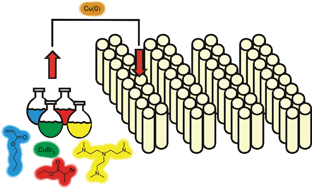
Graphical abstract: 4-Dibenzocyclooctynol (DIBO) as an initiator for poly(ε-caprolactone): copper-free clickable polymer and nanofiber-based scaffolds

In this context,  Becker and co-workers described a polymerization method utilizing 4-dibenzocyclooctynol (DIBO) as an initiator for the ring-opening polymerization of 3-caprolactone which yielded an end-functionalized PCL polymer. The DIBO group survived the relatively mild polymerization conditions and offered efficient, orthogonal and biocompatible functionalization opportunities for both the polymer and polymer-derivatized biomaterials. The combination of PCL and DIBO enabled large-scale production of a new type of easily functionalizable nanofiber-based scaffold with versatile regenerative medicine applications.

4-Dibenzocyclooctynol (DIBO) as an initiator for poly(ε-caprolactone): copper-free clickable polymer and nanofiber-based scaffolds by Laurent Chabanne, Stefan Pfirrmann, David J. Lunn and Ian Manners, Polym. Chem., 2013, 4, 2215-2218.

Julien Nicolas is a guest web-writer for Polymer Chemistry. He currently works at Univ. Paris-Sud (FR) as a CNRS researcher.

Digg This
Reddit This
Stumble Now!
Share on Facebook
Bookmark this on Delicious
Share on LinkedIn
Bookmark this on Technorati
Post on Twitter
Google Buzz (aka. Google Reader)

Paper of the week: Thiol–ene post-polymerization reactions on polyferrocenylsilane polymers

Block copolymers are known to self-assemble into micellar structures when placed in a solvent selective for one of the blocks. A range of morphologies have been reported, such as spherical, cylindrical and vesicular architectures. It has been previously shown that cylindrical micelles can be prepared from diblock copolymers containing a short, crystalline polyferrocenyldimethylsilane (PFDMS) block when placed in a solvent selective for the second longer block. Only a few examples of PFS-based cylindrical micelles with a metal-containing corona have been reported so far. Although PFSs with a range of properties have been developed by changing the substituent on silicon, this approach requires the development of a new monomer for each new material.

Graphical abstract: Controlled thiol–ene post-polymerization reactions on polyferrocenylsilane homopolymers and block copolymers

In this context,  Manners and co-workers reported an investigation of the reactions between various monofunctional thiols and vinyl-containing PFS scaffolds as a potential tool for the preparation of functional all-PFS materials. Thiol–ene click functionalization of PFS homopolymers was successfully carried out with a range of thiols, and the resulting materials were found to show interesting features (solubility, thermal transitions). Considering the diversity of available thiols and the great tolerance of the thiol–ene reaction towards functional groups, this post-polymerization route appears to be the candidate of choice for the preparation of PFS materials with a range of properties from the same homopolymer or diblock scaffold, thus avoiding the difficulties associated with the preparation of new monomers.

Controlled thiol–ene post-polymerization reactions on polyferrocenylsilane homopolymers and block copolymers by Laurent Chabanne, Stefan Pfirrmann, David J. Lunn and Ian Manners, Polym. Chem., 2013, 4, 2353-2360.

Julien Nicolas is a guest web-writer for Polymer Chemistry. He currently works at Univ. Paris-Sud (FR) as a CNRS researcher.

Digg This
Reddit This
Stumble Now!
Share on Facebook
Bookmark this on Delicious
Share on LinkedIn
Bookmark this on Technorati
Post on Twitter
Google Buzz (aka. Google Reader)

Paper of the week: Quasi-block copolymer libraries from an automated parallel synthesizer

Block copolymers are interesting materials that can self-assemble and segregate on nanometer length scales. This makes them ideal materials for numerous applications ranging from conventional technologies to emerging nanotechnologies. The synthesis of block copolymers is generally achieved via “living” ionic polymerization techniques or reversible-deactivation radical polymerization methods. However, the synthesis of well-defined block copolymers is, in general, a relatively low throughput, demanding, expensive and time-consuming process.

Graphical abstract: Quasi-block copolymer libraries on demand via sequential RAFT polymerization in an automated parallel synthesizer

In this context,  Chiefari and co-workers reported a convenient synthetic method for the systematic preparation of quasi-diblock copolymer libraries utilizing a sequential reversible addition–fragmentation chain transfer (RAFT) polymerization strategy. This approach used a commercially available parallel synthesizer, which allowed the unattended and fully automated synthesis of these libraries in a short period of time. The materials obtained in this investigation have shown properties very similar to those expected in “pure” diblock copolymers as determined by differential scanning calorimetry. The described method can be a useful and less expensive alternative for the rapid preparation and screening of block copolymer libraries.

Quasi-block copolymer libraries on demand via sequential RAFT polymerization in an automated parallel synthesizer by Carlos Guerrero-Sanchez, Lisa O’Brien, Colin Brackley, Daniel J. Keddie, Simon Saubern and John Chiefari, Polym. Chem., 2013, 4, 1857-1862.

Julien Nicolas is a guest web-writer for Polymer Chemistry. He currently works at Univ. Paris-Sud (FR) as a CNRS researcher.

Digg This
Reddit This
Stumble Now!
Share on Facebook
Bookmark this on Delicious
Share on LinkedIn
Bookmark this on Technorati
Post on Twitter
Google Buzz (aka. Google Reader)

Paper of the week: Well-defined temperature-sensitive surfactants for controlled emulsion coalescence

The stabilization of liquid–liquid interfaces through the adsorption of surfactants plays an important role in many industrial processes in which emulsions are produced or used. The main aim in the development of new surfactants is to provide prolonged shelf-life by preventing the coalescence of emulsion droplets. While the stability of an emulsion against coalescence is often the main aim in the formulation of emulsion systems, many applications of emulsions do not only require high stability against coalescence, but also the breaking or phase inversion of the emulsion at some point. At first, these requirements seem contradictory: the emulsion needs to be stable on the shelf, yet becomes unstable at some moment under the influence of a given stimulus.

Graphical abstract: Well-defined temperature-sensitive surfactants for controlled emulsion coalescence

In this context,  Sprakel and co-workers approached these contradictory constraints through the synthesis of well-defined thermoresponsive surfactants based on di(ethylene glycol)methacrylate and poly(ethylene glycol)methacrylate using Atom Transfer Radical Polymerization. The surfactants showed a Lower Critical Solution Temperature (LCST) of approximately 34°C, independent of molecular weight, which is ascertained by both Differential Scanning Calorimetry as well as Dynamic Light Scattering. Below the LCST, the surfactants stabilized the emulsions for at least four months. Above this temperature the hydrophilic block collapsed and coalescence between the emulsion droplets occurred; this led to demixing of the sample within several minutes. The authors revealed the mechanism for the temperature-triggered coalescence by measurements of the temperature-dependent interfacial tension and by studying the interfacial morphology of surfactant-covered emulsion droplets.

Well-defined temperature-sensitive surfactants for controlled emulsion coalescence by Huanhuan Feng, Nadine A. L. Verstappen, Alexander J. C. Kuehne and Joris Sprakel, Polym. Chem., 2013, 4, 1842-1847.

Julien Nicolas is a guest web-writer for Polymer Chemistry. He currently works at Univ. Paris-Sud (FR) as a CNRS researcher.

Digg This
Reddit This
Stumble Now!
Share on Facebook
Bookmark this on Delicious
Share on LinkedIn
Bookmark this on Technorati
Post on Twitter
Google Buzz (aka. Google Reader)

Paper of the week: Proton conducting phosphonic acid-functionalized polyolefins

Due to the properties arising from the synergism between the polyolefins and composites bearing polar functionalities, the unique behavior of these materials in bulk and in solution has led to emerging research in this area. Broad scientific effort, both fundamental and applied, has been devoted to obtain well-defined statistical, block and graft copolymers by covalently bonding polyolefins to amphiphilic polymers. It is well known that sequence distributions are major contributors in the adjustment of material properties in copolymers.

Graphical abstract: Synthesis of proton conducting phosphonic acid-functionalized polyolefins by the combination of ATRP and ADMET

In this context,  Markova et al. intended to use the synthetic advantages of acyclic diene metathesis (ADMET) polymerization (which offers a synthetic route to strictly linear polyethylenes functionalized at precise intervals) for the formation of new membrane materials for low temperature fuel cells. Well-defined, precise poly(vinylbenzyl phosphonic acid) (PVBPA)-containing-polyolefins were obtained for the first time by a combination of ADMET and atom transfer radical polymerization (ATRP), yielding a set of well-defined graft copolymers composed of polyethylene (PE) “backbone” and PDEVBP brushes, precisely placed on every 21st carbon. Quantitative deprotection of the phosphonates led to the corresponding polymer bonded phosphonic acids. The PA-containing electrolytes exhibited sufficient thermal properties with a high mobility for proton conduction. Moreover, the enhancement of the proton conductivity properties compared to the existing phosphonic acid containing block copolymer structures, the improved properties in the high temperature operating regime and the conductivity range  make them interesting membrane materials for future studies.

Synthesis of proton conducting phosphonic acidfunctionalized polyolefins by the combination of ATRP and ADMET by Dilyana Markova, Kathleen L. Opper, Manfred Wagner, Markus Klapper, Kenneth B. Wagener and Klaus Mullen, Polym. Chem., 2013, 4, 1351-1363.

Julien Nicolas is a guest web-writer for Polymer Chemistry. He currently works at Univ. Paris-Sud (FR) as a CNRS researcher.

Digg This
Reddit This
Stumble Now!
Share on Facebook
Bookmark this on Delicious
Share on LinkedIn
Bookmark this on Technorati
Post on Twitter
Google Buzz (aka. Google Reader)

Paper of the week: Plastic reusable pH indicator strips

pH-sensitive anionic dyes have been widely used in scientific research and industrial applications. The most common pH test approach generally utilizes papers as the substrate which absorbed pH-sensitive dyes. However, pH test papers often suffer from the leaching of dyes into solution, and the contamination of the samples which can result in anomalous readings. In the past years, plastic pH-sensitive strips have been prepared by immobilizing small molecular pH-sensitive dyes into the polymer matrix via the adsorption or entrapment approach. However, the physical entrapment may lead to a gradual loss of dyes from the substrates, which therefore limits the sensor stability and long-term practical applications. Therefore, various polymers with covalently bonded pH-sensitive moieties have been recently developed for the pH test.

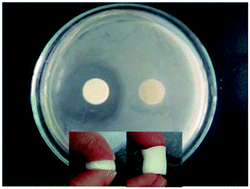
Graphical abstract: Plastic reusable pH indicator strips: preparation via anion-exchange of poly(ionic liquids) with anionic dyes

In their study, Yan and co-workers  reported a facile and effective strategy for the preparation of plastic pH indicator strips and the characterization of their pH sensitivity. They focused their attention on poly(ionic liquids) (PILs) due to their excellent ion exchange capability, enabling the preparation of PILs with a variety of counteranions by polymerization of only one IL monomer and followed by anion-exchange reactions. The pH-sensitive strips were prepared via the cross-linking of imidazolium type IL monomers with acrylonitrile and followed by anion-exchange with sulfonated anionic dyes which bear their negative charge in a wide pH range. The resultant pH indicator strips exhibited enhanced pH-responsive colour changes and robust pH-response reversibility in both aqueous and organic solutions.

Plastic reusable pH indicator strips: preparation via anion-exchange of poly(ionic liquids) with anionic dyes by Jiangna Guo, Lihua Qiu, Zhijun Deng and Feng Yan, Polym. Chem., 2013, 4, 1309-1312.

Julien Nicolas is a guest web-writer for Polymer Chemistry. He currently works at Univ. Paris-Sud (FR) as a CNRS researcher.

Digg This
Reddit This
Stumble Now!
Share on Facebook
Bookmark this on Delicious
Share on LinkedIn
Bookmark this on Technorati
Post on Twitter
Google Buzz (aka. Google Reader)

Paper of the week: A novel supramolecular polymer via host–guest and charge-transfer interactions

Supramolecular polymers, defined as polymeric arrays of many repeating units held together by reversible and weak non-covalent interactions, are considered as the result of the combination of supramolecular chemistry and polymer science. Non-covalent interactions, such as multiple hydrogen bonding, host–guest interactions and metal-coordination, have been introduced to fabricate supramolecular polymers, and these reversible and highly directional secondary interactions endow supramolecular polymers with novel topological structures and unique functions. Charge transfer complexes, prepared by the association between an electron acceptor and an electron donor, have been proved to be important and attractive building blocks for the construction of multiple supramolecular aggregates.

Graphical abstract: A supramolecular polymer formed by the combination of crown ether-based and charge-transfer molecular recognition

In this view, Huang and co-workers reported on the design and the synthesis of a novel supramolecular polymer constructed from two heteroditopic monomers driven by the combination of crown ether-based and charge-transfer molecular recognition. High molecular weight supramolecular polymers were formed by complexation between crown ethers and secondary ammonium salts, and paraquat derivatives and pyrene derivatives, respectively. This kind of supramolecular polymer exhibited the ability to construct nanofibers via electrospinning technology.

A supramolecular polymer formed by the combination of crown ether-based and charge-transfer molecular recognition by Shengyi Dong, Lingyan Gao, Jianzhuang Chen, Guocan Yu, Bo Zheng and Feihe Huang, Polym. Chem., 2013, 4, 882-886.

Julien Nicolas is a guest web-writer for Polymer Chemistry. He currently works at Univ. Paris-Sud (FR) as a CNRS researcher.

Digg This
Reddit This
Stumble Now!
Share on Facebook
Bookmark this on Delicious
Share on LinkedIn
Bookmark this on Technorati
Post on Twitter
Google Buzz (aka. Google Reader)

Paper of the week: High-throughput synthesis of cyclodextrin-based polyurethanes

A wide range of pharmaceuticals that are not completely metabolized in humans or animals are discharged into aquatic environments through a variety of sources including homes, hospitals, pharmaceutical manufactures, and animal feeding operations. The potential hazard of pharmaceuticals in waters depends on their persistence and the biological activity of their degradation by-products; some of them have been demonstrated to be harmful not only to ecosystems but also to human health. Consequently, there is a need for their detection at trace levels and efficient removal from waters. Both applications require sorbents with enhanced binding properties of the targeted pharmaceuticals.

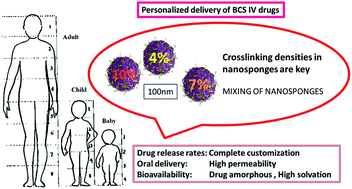
Graphical abstract: Design and high-throughput synthesis of cyclodextrin-based polyurethanes with enhanced molecular recognition properties

In oder to develop materials with recognition properties, Shahgaldian used cyclodextrins (CDs) for their known ability to include hydrophobic drugs into their cavity. Nevertheless, as the range of molecules known to form inclusion complexes with CDs is fairly broad, one can expect that the produced polymers will exhibit a lack of selectivity. With this in mind, 51 water-insoluble cyclodextrin-based polyurethanes were synthesized using a high-throughput approach. The selective molecular recognition properties of the produced polyurethanes were investigated by measuring their capability to bind ten selected compounds from aqueous solutions. Interestingly, the results indicated that the influence of different CDs on the selective molecular recognition properties was fairly limited. It was demonstrated that the selective molecular recognition properties can be suitably designed and optimized by tuning their compositions and successfully applied for selective binding of targets under purely aqueous conditions.

Design and high-throughput synthesis of cyclodextrin-based polyurethanes with enhanced molecular recognition properties by Pu Xiao , Philippe F.-X. Corvini , Yves Dudal and Patrick Shahgaldian, Polym. Chem., 2013, 4, 942-946.

Julien Nicolas is a guest web-writer for Polymer Chemistry. He currently works at Univ. Paris-Sud (FR) as a CNRS researcher.
Digg This
Reddit This
Stumble Now!
Share on Facebook
Bookmark this on Delicious
Share on LinkedIn
Bookmark this on Technorati
Post on Twitter
Google Buzz (aka. Google Reader)