Archive for the ‘Hot articles’ Category

This week’s HOT papers featuring recent advances in the synthesis of aromatic nitro compounds and more…

Recent advances in the synthesis of aromatic nitro compounds
Guobing Yan and Minghua Yang
DOI: 10.1039/c3ob27354g  

recent advances in the synthesis of aromatic nitro compounds  

Free to access for 4 weeks


Facile dimethylarsenic exchange and pyramidal inversion in its cysteine and glutathione adducts
D. Scott Bohle and Yuxuan Gu
DOI: 10.1039/c3ob40268a 

Facile dimethylarsenic exchange and pyramidal inversion in its cysteine and glutathione adducts  

Free to access for 4 weeks  


PEGylation enables the specific tumor accumulation of a peptide identified by phage display
Walter Mier, Susanne Krämer, Sabine Zitzmann, Annette Altmann, Karin Leotta, Ursula Schierbaum, Martina Schnölzer, Michael Eisenhut and Uwe Haberkorn
DOI: 10.1039/c3ob27475f  


PEGylation enables the specific tumor accumulation of a peptide identified by phage display   

Free to access for 4 weeks  


Synthetic use of the primary kinetic isotope effect in hydrogen atom transfer 2: generation of captodatively stabilised radicals
Mark E. Wood, Sabine Bissiriou, Christopher Lowe and Kim M. Windeatt
DOI: 10.1039/c3ob40275d  

Synthetic use of the primary kinetic isotope effect in hydrogen atom transfer 2: generation of captodatively stabilised radicals   

Free to access for 4 weeks  


Digg This
Reddit This
Stumble Now!
Share on Facebook
Bookmark this on Delicious
Share on LinkedIn
Bookmark this on Technorati
Post on Twitter
Google Buzz (aka. Google Reader)

“On-water” catalysis to facilitate chemical transformations: read Chris McErlean’s comments on this new methodology

We are delighted to have received the authors’ comments from Christopher S. P. McErlean on the recently published HOT article “Revitalizing the aromatic aza-Claisen rearrangement: implications for the mechanism of ‘on-water’ catalysis”.

“Chemistry creates. It is the only discipline in which you can design or imagine a new entity and then go away and build it. Of course, it is always easier said than done, so synthetic organic chemists spend a good deal of their time exploring ways to build molecules more efficiently. That’s what the McErlean Research Group does at the University of Sydney. We are primarily focused on making synthesis easier.

Every undergraduate chemist knows that the aromatic Claisen rearrangement is a great way to build functionalized phenols. The reaction is so prevalent in heterocycle synthesis that we tend not to reference the original work – it is assumed knowledge. Our group envisaged that the aromatic aza-Claisen rearrangement would be an equally powerful way to make functionalised anilines, but the known reaction conditions are just too forcing to be useful.

“On-water” reactions rely on interfacial water to catalyze chemical transformations. Exactly how the interfacial water does this has been the source of much recent debate. Most of the protagonists have relied on computationally derived evidence to support one theory or another. We thought that we could kill two birds with one stone by using on-water catalysis to facilitate the aromatic aza-Claisen rearrangement and probe the kinetics of this transformation.

The outcomes of our work are twofold: an easy way to build functionalised naphthylamines and anilines, and experimental evidence that supports the acid-catalyzed nature of on water chemistry.

We hope that chemists employ this operationally simple synthetic tool to build life-changing molecules, and we hope that our results will spur more experimental chemists to provide hard data regarding the on-water phenomenon.”

This Communication is free to access for the next 4 weeks!

Revitalizing the aromatic aza-Claisen rearrangement: implications for the mechanism of ‘on-water’ catalysis
Kaitlin D. Beare and Christopher S. P. McErlean
DOI: 10.1039/C3OB40118A   

Revitalizing the aromatic aza-Claisen rearrangement: implications for the mechanism of ‘on-water’ catalysis

Interested in Christopher S. P. McErlean‘s research? Why not also read these recently published articles:

An in-water, on-water domino process for synthesis
Norcott, Philip; Spielman, Calan; McErlean, Christopher S. P.
Green Chem., 2012, 14, 605.
DOI: 10.1039/c2gc16259h

Total synthesis of C-19 lipid diols containing a 2,5-disubstituted-3-oxygenated tetrahydrofuran
Nesbitt, Caroline L.; McErlean, Christopher S. P.
Org. Biomol. Chem., 2011, 9, 2198.
DOI: 10.1039/c0ob00754d

Digg This
Reddit This
Stumble Now!
Share on Facebook
Bookmark this on Delicious
Share on LinkedIn
Bookmark this on Technorati
Post on Twitter
Google Buzz (aka. Google Reader)

This week’s HOT papers featuring the total synthesis of (±)-sacidumlignans D and A and much more

Total synthesis of (±)-sacidumlignans D and A through Ueno–Stork radical cyclization reaction
Jian-Jian Zhang, Chang-Song Yan, Yu Peng, Zhen-Biao Luo, Xiao-Bo Xua and Ya-Wen Wang
DOI: 10.1039/ C3OB00053B 

 Total synthesis of (±)-sacidumlignans D and A through Ueno–Stork radical cyclization reaction   

Free to access for 4 weeks 


A traceless aryl-triazene linker for DNA-directed chemistry
Christian Hejesen, Lars K. Petersen, Nils Jakob V. Hansen and Kurt V. Gothelf
DOI: 10.1039/C3OB27504C   

 A traceless aryl-triazene linker for DNA-directed chemistry  

   Free to access for 4 weeks  


Revitalizing the aromatic aza-Claisen rearrangement: implications for the mechanism of ‘on-water’ catalysis
Kaitlin D. Beare and Christopher S. P. McErlean
DOI: 10.1039/C3OB40118A   

Revitalizing the aromatic aza-Claisen rearrangement: implications for the mechanism of ‘on-water’ catalysis   

Free to access for 4 weeks  


Reversible protein affinity-labelling using bromomaleimide-based reagents
Ramiz I. Nathani, Vijay Chudasama, Chris P. Ryan, Paul R. Moody, Rachel E. Morgan, Richard J. Fitzmaurice, Mark E. B. Smith, James R. Baker and Stephen Caddick
DOI: 10.1039/C3OB40239H 


Reversible protein affinity-labelling using bromomaleimide-based reagents     

Free to access for 4 weeks

Digg This
Reddit This
Stumble Now!
Share on Facebook
Bookmark this on Delicious
Share on LinkedIn
Bookmark this on Technorati
Post on Twitter
Google Buzz (aka. Google Reader)

HOT- Novel regio- and chemoselective C–H oxygenation

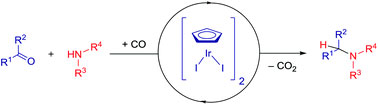
In this HOT article, Rao and co-workers report a novel Rh(II) and Ru(II) catalysed regio- and chemoselective C-H oxygenation for the facile synthesis of a variety of functionalised phenols from easily accessible arenes. The reaction demonstrates excellent reactivity, ortho-selectivity, good functional group tolerance and high yields. This practical method allowed the synthesis of a few 2-acylphenols in gram-scale and its utility has been well exemplified in further applications in heterocycle synthesis and direct modification of drug Fenofibrate.

Rh(II) or Ru(II) catalyzed C–H oxygenation of aryl ketones for the facile synthesis of diverse functionalized phenols

Broadening the catalyst and reaction scope of region- and chemoselective C–H oxygenation: a convenient and scalable approach to 2-acylphenols by intriguing Rh(II) and Ru(II) catalysis
Gang Shan, Xuesong Han, Yun Lin, Shanyou Yu and Yu Rao
DOI: 10.1039/C3OB27457H

Free to access for 4 weeks

Digg This
Reddit This
Stumble Now!
Share on Facebook
Bookmark this on Delicious
Share on LinkedIn
Bookmark this on Technorati
Post on Twitter
Google Buzz (aka. Google Reader)

HOT-Regioselective C2-arylation of imidazo[4,5-b]pyridines

In this HOT paper, Blagg and coworkers at the Institute of Cancer Research, Sutton, report an efficient C2-functionalisation via direct C–H arylation for N3-MEM-protected imidazo[4,5-b]pyridines. The imidazo[4,5-b]pyridine heterocycle is a versatile purine isostere and important ring system which has seen a recent growth in medicinal chemistry application of potential therapeutic benefit; for example in protein kinase inhibitors for the treatment of cancer, inflammatory disease and diabetes. This methodology allows easy access to 2,7- and 2,6-disubstituted derivatives from common intermediates in an approach amenable to the divergent synthesis of analogues and which is applicable to rapid medicinal chemistry exploration of this emerging purine isostere.

Direct C2-H arylation of 6- and 7-substituted imidazo[4,5-b]pyridines

Regioselective C2-arylation of imidazo[4,5-b]pyridines
Jonathan Macdonald, Victoria Oldfield, Vassilios Bavetsias and Julian Blagg
DOI: 10.1039/C3OB27477B

Free to access for 4 weeks

Digg This
Reddit This
Stumble Now!
Share on Facebook
Bookmark this on Delicious
Share on LinkedIn
Bookmark this on Technorati
Post on Twitter
Google Buzz (aka. Google Reader)

HOT-2,4-Disubstituted thiazole derivatives as small molecule modulators of cellular development

In this HOT paper, Marder, Whiting, Przyborski and co-workers investigate the ability of thiazole-containing small molecules to induce the differentiation of human pluripotent stem cells and their derivatives. Understanding how the structure of molecules relates to their function and biological activity is essential in the development of new analogues with targeted activity. This is especially relevant in mediating developmental processes in mammalian cells and the regulation of stem cell differentiation. This study provides further insight into the complexity of compound design in terms of developing small molecules with specific biological activities to control the development and differentiation of mammalian cells.

Synthesis and applications of 2,4-disubstituted thiazole derivatives as small molecule modulators of cellular development
Garr-Layy Zhou, Daniel M. Tams, Todd B. Marder, Roy Valentine, Andrew Whiting and Stefan A. Przyborski
DOI: 10.1039/C3OB00005B

Free to access for 4 weeks

Digg This
Reddit This
Stumble Now!
Share on Facebook
Bookmark this on Delicious
Share on LinkedIn
Bookmark this on Technorati
Post on Twitter
Google Buzz (aka. Google Reader)

March’s HOT articles

These articles are HOT as recommended by the referees. And we’ve made them free to access for 4 weeks.

Host–guest complexation driven dynamic supramolecular self-assembly
 
Huacheng Zhang, Kim Truc Nguyen, Xing Ma, Hong Yan, Junfei Guo, Liangliang Zhu and Yanli Zhao

Org. Biomol. Chem.
, 2013, DOI: 10.1039/C2OB27340C

Free to access untill 11th April

 
Mario Altendorfer, Aruna Raja, Florenz Sasse, Herbert Irschik and Dirk Menche

Org. Biomol. Chem.
, 2013, DOI: 10.1039/C2OB26906F
Free to access untill 11th April


Digg This
Reddit This
Stumble Now!
Share on Facebook
Bookmark this on Delicious
Share on LinkedIn
Bookmark this on Technorati
Post on Twitter
Google Buzz (aka. Google Reader)

HOT – Phenanthrolines stabilising G-quadruplexes

Synthesis and binding studies of novel di-substituted phenanthroline compounds with genomic promoter and human telomeric DNA G-quadruplexes
Chunying Wei, Yanbo Wang, Meiying Zhang
DOI: 10.1039/C3OB27426H

Researchers in China have developed a series of phenanthroline molecules that interact with human telomeric DNA G-quadruplexes, which are promising targets in anti-cancer drug discovery.

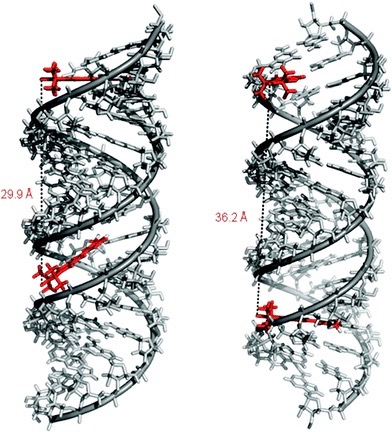
Synthesis and binding studies of novel di-substituted phenanthroline compounds with genomic promoter and human telomeric DNA G-quadruplexes G-quadruplexes are guanine-rich nucleic acid sequences. The guanine bases can hydrogen bond to form tetrads, and these tetrads can then stack up to form a G-quadruplex. They are significant in telomeres as their formation inhibits the telomerase enzyme, which is implicated in the onset of around 85% of cancers.

G-quadruplexes are also increasingly being found in non-telomeric parts of the chromatid, such as genomic promoter regions. Their presence and purpose is still not fully understood although they have also been implicated in cell aging and the formation of cancerous cells. For these reasons, G-quadruplexes are pretty promising targets for drug discovery.

Phenanthrolines can stabilise telomeric G-quadruplexes, and some have shown excellent inhibition of the telomerase enzyme. Before now, interactions between phenanthrolines and promoter G-quadruplexes have been relatively unstudied.

In this HOT article, Chunying Wei and co-workers at the Key Laboratory of Chemical Biology and Molecular Engineering at Shanxi University have synthesised six novel di-substituted phenanthroline molecules. They have also probed their interaction with human telomere and promoter G-quadruplexes. They have found that the compounds significantly inhibit the telomerase enzyme at low micromolar concentrations.

It is hoped that these molecules will aid and inspire the design of new anti-cancer drugs.

Annabella Newton is an organic chemist based in Melbourne, Australia. Until recently, she was a postdoctoral researcher and she has just started work as a trainee patent attorney with Phillips Ormonde Fitzpatrick.

Digg This
Reddit This
Stumble Now!
Share on Facebook
Bookmark this on Delicious
Share on LinkedIn
Bookmark this on Technorati
Post on Twitter
Google Buzz (aka. Google Reader)

HOT – A new approach to inhibit human β-tryptase

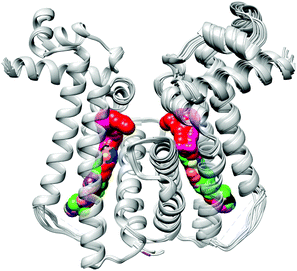
In this HOT article Carsten Schmuck and co-workers report the synthesis and evaluation of a series of four-armed peptide ligands that can inhibit β-tryptase. These tetravalent ligands are made up of 2 sets of arms incorporating the artificial arginine analogue guanidiniocarbonyl pyrrole cation and can inhibit β-tryptase in a reversible and non-competitive way by binding to anionic hotspots on the surface of the enzyme.

Read the complete study for free for 4 weeks!

A new approach to inhibit human β-tryptase by protein surface binding of four-armed peptide ligands with two different sets of arms
Qian-Qian Jiang, Lina Bartsch, Wilhelm Sicking, Peter R. Wich, Dominik Heider, Daniel Hoffmann and Carsten Schmuck
DOI: 10.1039/C3OB27302D

Digg This
Reddit This
Stumble Now!
Share on Facebook
Bookmark this on Delicious
Share on LinkedIn
Bookmark this on Technorati
Post on Twitter
Google Buzz (aka. Google Reader)

HOT – Synthesis of helically twisted [1 + 1]macrocycles

Synthesis of helically twisted [1 + 1]macrocycles assisted by amidinium–carboxylate salt bridges and control of their chiroptical properties

Over the past few decades a lot of interest has been given to macrocycles with a twisted structure that has a preferred direction and show an optical chirality due to their possible uses in many areas such as in materials for chiral recognition.

In this HOT paper Eiji Yashima and colleagues from Nagoya University report the design and synthesis of three helically twisted [1 + 1]macrocycles, whose chirality can be controlled by acid–base interactions and zinc coordination.

Yashima et al. connect the twisted [1 + 1]macrocycles using via o-, m-, and p-linkages and use chiral amidinium–carboxylate salt bridges as a versatile structural motif to control the twisting motion of the macrocycles.

Find out all of the details of this study by downloading this paper. It’s free to access for 4 weeks.

Synthesis of helically twisted [1 + 1]macrocycles assisted by amidinium–carboxylate salt bridges and control of their chiroptical properties
Yuji Nakatani, Yoshio Furusho and Eiji Yashima
DOI: 10.1039/C2OB27054D

Digg This
Reddit This
Stumble Now!
Share on Facebook
Bookmark this on Delicious
Share on LinkedIn
Bookmark this on Technorati
Post on Twitter
Google Buzz (aka. Google Reader)