Author Archive

Recycling rare earth elements using ionic liquids

Recycling old magnets, so that rare-earth metals can be re-used, could help to solve an urgent raw material supply problem in the electronics industry. Researchers from the University of Leuven, Belgium, have used ionic liquids to separate neodymium and samarium from transition metals like iron, manganese and cobalt – all elements that are used in the construction of permanent rare-earth magnets, which are found in electronic devices ranging from hard drives to air conditioners and wind turbines.
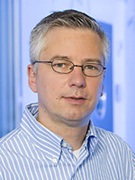
‘The process involves the liquid-liquid extraction of rare-earth metals from the other elements present in neodymium-iron-boron and samarium-cobalt magnets,’ explains Koen Binnemans who leads the group developing the process. ‘These other elements – including iron, cobalt, manganese, copper and zinc – are extracted into the ionic-liquid phase, while the rare-earth metals are left behind in the aqueous phase,’ he says, adding that the ionic liquid itself – trihexyl(tetradecyl)phosphonium chloride – can also be re-used, after the transition metals have been stripped out.

In traditional liquid-liquid extractions of metal ions, an aqueous phase containing the metal salt is mixed with an organic phase containing an extraction agent. Simple though they are, these processes use organic phases comprising flammable and volatile solvents, like toluene, kerosene or diethyl ether. Ionic liquids are far more environmentally friendly, having very low vapour pressure and non-flammability.

Read the full article in Chemistry World

Read the original journal article in Green Chemistry:

Removal of transition metals from rare earths by solvent extraction with an undiluted phosphonium ionic liquid: separations relevant to rare-earth magnet recycling
Tom Vander Hoogerstraete,  Sil Wellens,  Katrien Verachtert and Koen Binnemans
Green Chem., 2013,15, 919-927

Digg This
Reddit This
Stumble Now!
Share on Facebook
Bookmark this on Delicious
Share on LinkedIn
Bookmark this on Technorati
Post on Twitter
Google Buzz (aka. Google Reader)

Green Chemistry Issue 4 now online

Green Chemistry issue 4 is now online and you can read it here.

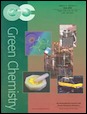
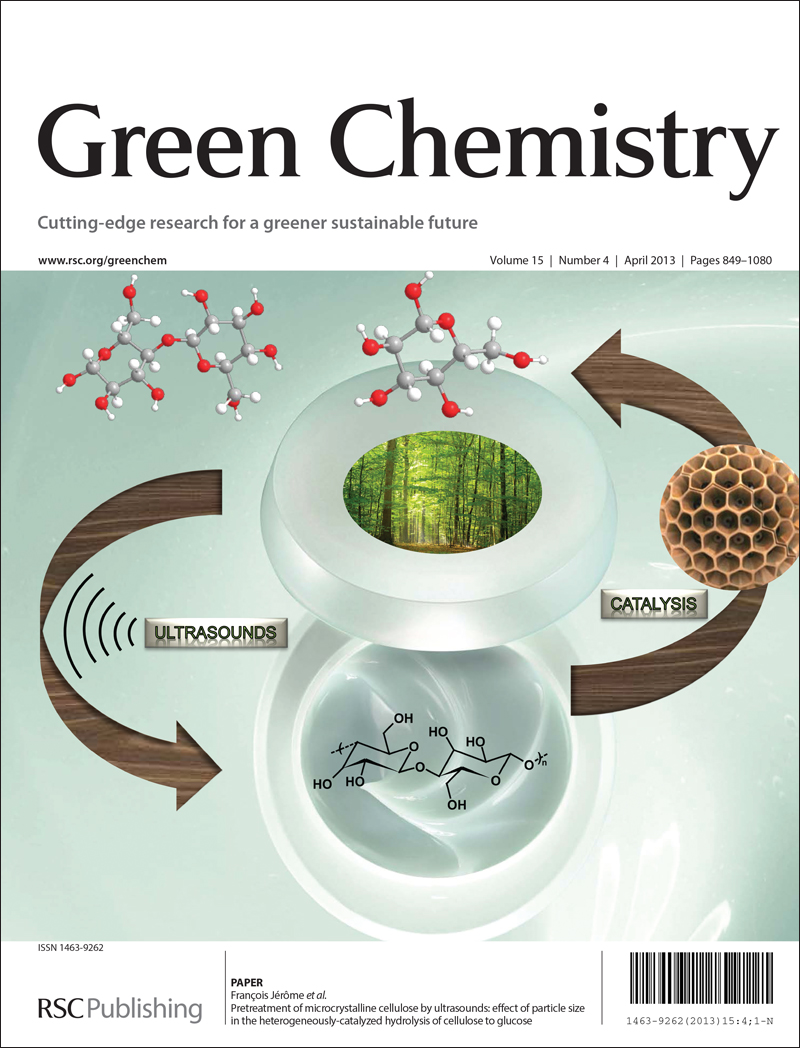
Issue 4 front coverThe cover features work by François Jérôme and co-workers from France.  Their Paper, ‘Pretreatment of microcrystalline cellulose by ultrasounds: effect of particle size in the heterogeneously-catalyzed hydrolysis of cellulose to glucose’ demonstrates that activity of a sulfonated carbon in the heterogeneously-catalyzed hydrolysis of cellulose was greatly improved by assistance of ultrasound. The paper demonstrates that the sonication method was as effective as conventional pre-treatments such as ball-milling or ionic liquids.

Pretreatment of microcrystalline cellulose by ultrasounds: effect of particle size in the heterogeneously-catalyzed hydrolysis of cellulose to glucose
Qinghua Zhang, Maud Benoit, Karine De Oliveira Vigier, Joël Barrault, Gwenaëlle Jégou, Michel Philippe and François Jérôme, Green Chem., 2013, 15, 963-969

Issue 4 inside cover

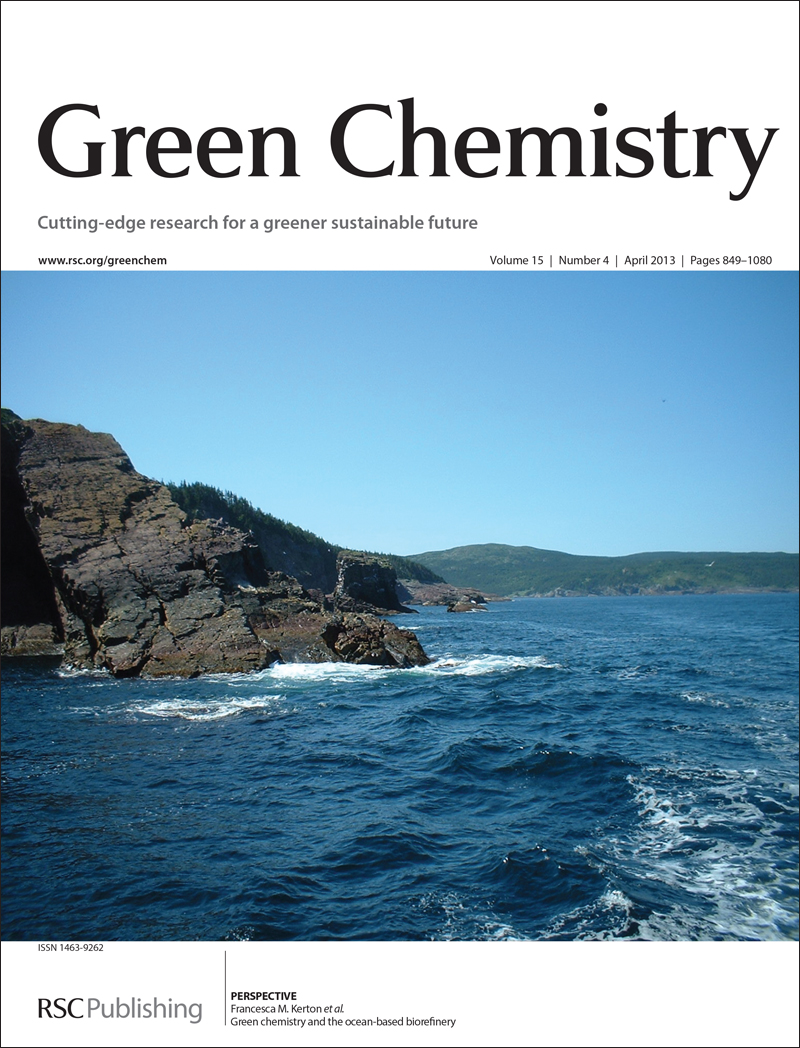
The inside front cover highlights a review article entitled ‘Green chemistry and the ocean-based biorefinery’ by Fran Kerton and co-workers at the Memorial University of Newfoundland in Canada.  This review highlights that competition for land use could be minimized if marine sourced feedstocks were used for chemicals and materials production rather than crops grown on fertile land. It focuses on achievements and potential opportunities surrounding the use of algae and waste from shellfish and finfish processing.

Green chemistry and the ocean-based biorefinery
Francesca M. Kerton, Yi Liu, Khaled W. Omari and Kelly Hawboldt, Green Chem., 2013, 15, 860-871

These articles are free to access for 6 weeks!

Keep up-to-date with the latest content in Green Chemistry by registering for our free table of contents alerts.

Digg This
Reddit This
Stumble Now!
Share on Facebook
Bookmark this on Delicious
Share on LinkedIn
Bookmark this on Technorati
Post on Twitter
Google Buzz (aka. Google Reader)

Green Chemistry 15 years on…

In January 1999 the first issue of Green Chemistry was published with an Editorial written by James Clark, setting out his vision for the Journal.

GC 1999 Issue 1 Cover jpg

1999: First cover of Green Chemistry

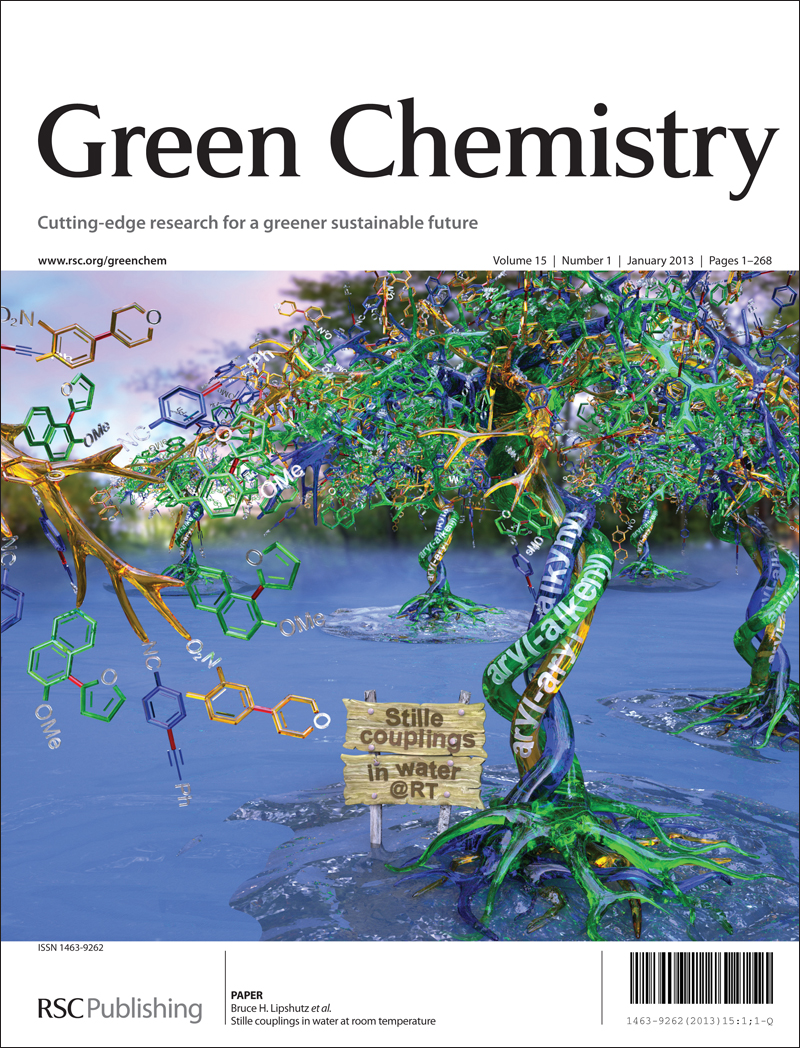
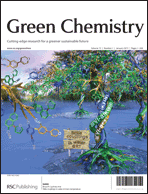
Green Chemistry, 2013, Vol. 15, issue 1 front cover

GC, Vol. 15, issue 1 front cover

To mark the occasion of the Journal entering it’s fifteenth year of publication in 2013 we will be having a number of interesting articles asking those scientists who have contributed to the Journal strategy to reflect on how the subject has changed over the last 15 years and asking them for their vision on the subject in the future. 

We will also be highlighting those papers that have been most cited over the years – the papers that you as readers have been citing the most. 

Details about all of these activities will be posted on the Green Chemistry blog throughout 2013.

Digg This
Reddit This
Stumble Now!
Share on Facebook
Bookmark this on Delicious
Share on LinkedIn
Bookmark this on Technorati
Post on Twitter
Google Buzz (aka. Google Reader)

Sustainability in Chemical Synthesis Conference

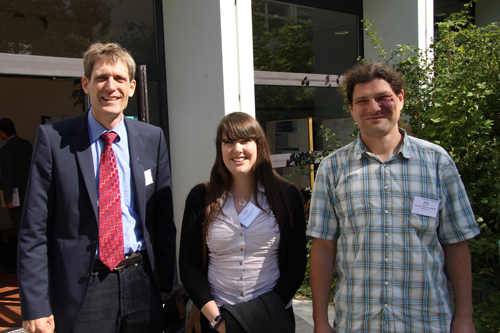
Anna Simpson, Deputy Editor of Green Chemistry (pictured below, centre) attended the Sustainability in Chemical Synthesis Conference, held at the Chemistry Department of TU Kaiserslautern from the 16th -18th September. 

Kaiserslautern

From left to right: Lukas Gooßen, Anna Simpson and Oliver Kreye

This meeting was organised by the Sustainable Chemistry Section of the Gesellschaft Deutscher Chemiker (German Chemical Society, GDCh).  The series was started in 2007 to bring scientists from the community of sustainable chemistry together for exchanging ideas and new scientific insights. 

The 2012 scientific programme put an emphasis on state-of-the-art organic synthesis by covering, in particular, methods of carbon-carbon, carbon-hetroatom, and carbon-hydrogen bond formation.  Topics on chemicals from biomass were similarly covered as was the invention of new catalytic processes for achieving valuable new chemical transformations.

The Green Chemistry poster prize was won by Oliver Kreye from the Karlsruhe Institute of Technology (far right in picture above) and it was presented by Professor Lukas Gooßen, co-organiser of the conference (far left in picture above).

The full title of the winning poster was The first catalytic Lossen rearrangement: Sustainable access to Carbamates and Amines, authored by: Oliver Kreye, Sarah Wald and Michael Meier.  You may be interested in ‘meeting our author’ Michael Meier, click here.

Congratulations to Oliver on winning this prize.

Digg This
Reddit This
Stumble Now!
Share on Facebook
Bookmark this on Delicious
Share on LinkedIn
Bookmark this on Technorati
Post on Twitter
Google Buzz (aka. Google Reader)

How synthetic organic chemistry can help to feed the world

Azoxystrobin is the world’s leading agricultural fungicide. It is a fully synthetic compound, whose invention was inspired by the structure and activity of the naturally-occurring fungicide strobilurin A. Today it is used worldwide to control fungi growing on over 120 types of crop, improving plant health, raising quality and increasing yield. The success of the project highlights the crucial importance of chemistry in meeting grand challenges such as global food security and the broader applicability of skills such as natural product synthesis. Keynote speaker Dr John Clough led the team of chemists at Syngenta that invented azoxystrobin. He will discuss the key role that synthetic organic chemistry played in creating an effective and safe fungicide. This policy event is organised by the Royal Society of Chemistry as part of a series of lectures designed to bring together active researchers and policy makers to highlight the role of the chemical sciences in tackling societal issues.

Be inspired - The Chemistry Centre

This event will be held in the Chemistry Centre on 26 September at the RSC’s recently refurbished building in Burlington House, London. Doors will open at 17:30 for refreshments. The event will begin at 18:00 and will finish with a wine reception. Please follow the link here for information and to register for the event.

If you cannot make it why not watch the video of the event which will be uploaded on the website after the event.

Digg This
Reddit This
Stumble Now!
Share on Facebook
Bookmark this on Delicious
Share on LinkedIn
Bookmark this on Technorati
Post on Twitter
Google Buzz (aka. Google Reader)

New Editorial Board Chair for Green Chemistry

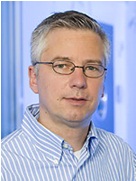
We are delighted to announce the appointment of Walter Leitner as the new Chair of the Green Chemistry Editorial Board. 

Walter Leitner

Walter Leitner

Walter is a full professor at Technische Chemie und Petrolchemie, Institut für Technische Chemie und Makromolekulare Chemie at the RWTH Aachen University and has been involved in the development of the Journal through his role as Scientific Editor. We look forward to the start of a new era with Walter as Chair of the Green Chemistry Editorial Board.

Martyn Poliakoff

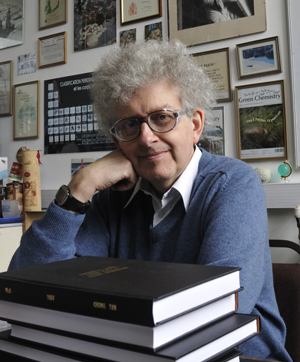
The start of a new era must, unfortunately, see the end of another and after six years as Chair of the Editorial Board Martyn Poliakoff is stepping down.  Green Chemistry is privileged to have been guided by one of the most prominent green chemists and we wish to thank Martyn for all his hard work and endless enthusiasm he has brought to the Journal.  Martyn bids the journal farewell in a recently published editorial entitled ‘Paul Anastas and the Robin Hood Question’
Intrigued? Find out more by reading the Editorial here.

Keep up-to-date with the latest content in Green Chemistry by registering for our free table of contents alerts.

Digg This
Reddit This
Stumble Now!
Share on Facebook
Bookmark this on Delicious
Share on LinkedIn
Bookmark this on Technorati
Post on Twitter
Google Buzz (aka. Google Reader)

Incredible ionic liquids: an article collection

Ionic liquids are pretty self explanatory; they are ionic materials in a liquid state. In a ‘normal’ liquid, interactions are usually governed by Van de Waals or H-bonding forces. In ionic liquids it is ionic bonding interactions which dominate, meaning ionic liquids possess some interesting and unique properties.

The field of ionic liquids grew after Paul Walden’s observations of ethylammonium nitrate in 1914,1 since then the study and use of ionic liquids has grown phenomenally, with applications in analytics, biology, electrochemistry, physical chemistry, engineering, solvents and catalysis.

The academic and industrial interest in ionic liquids has thrown up some remarkable discoveries, particularly in recent years, so to keep you up to date with latest break-through research in the field we have collected these high quality articles which are free to access!*

(more…)

Digg This
Reddit This
Stumble Now!
Share on Facebook
Bookmark this on Delicious
Share on LinkedIn
Bookmark this on Technorati
Post on Twitter
Google Buzz (aka. Google Reader)

Putting Green Chemistry into Mobile Apps to Communicate Globally

Screenshot of the Green Solvents App for iPad

Screenshot of the Green Solvents App for iPad

Several new mobile applications (Apps) have been recently released for the Apple iOS platform which incorporate green chemistry concepts. This represents a highly novel way to communicate science and bring green chemistry to a bigger audience, which has not previously been appreciated. We certainly sense there is an untapped audience for these types of applications due to the large number of people who now own a mobile device across all demographics. Green Chemistry related information is generally proprietary and papers on the topic are commonly behind paywalls. Making the information freely available or at low cost is a paradigm shift.

For example, a recent consortium organized by the American Chemical Society Green Chemistry InstituteTM (ACS GCI) Pharmaceutical Roundtable1 currently involves 14 pharmaceutical companies, and has developed a solvent selection guide that is publicly available on their website in the form of a PDF file.2 We have made this solvent selection guide more accessible in the form of a free app called Green Solvents.3, 4 It is delivered as a simple structure look-up guide incorporating all of the selection criteria from the ACS GCI and, in addition, having links out to other useful resources (ChemSpider 5-7 etc.). This app, like most free apps, has a small banner advertisement which does not detract from the content of the app or its usability on a mobile device. Importantly this App was not funded by the ACS or any other organization.

Screenshot of the Open Drug Discovery Teams App for iPad

Screenshot of the Open Drug Discovery Teams App for iPad

Creating the Green Solvents app has also motivated the addition of the process mass intensity (PMI) calculation8 (which is another green chemistry feature), into the Yield101 app9. A third recently developed mobile app connected to green chemistry is the Open Drug Discovery Teams (ODDT) app10, 11. ODDT is a free mobile app intended as a research topic aggregator of science data collected from various sources on the internet such as Twitter and Google Alerts. It exists to facilitate interdisciplinary teamwork and deliver access to information that is highly relevant and focused on the topic areas of interest. Research topics include areas of chemistry and adjacent molecule-oriented biomedical sciences, with an emphasis on those which are most amenable to open research at present. We have focused on green chemistry as a topic due to its potential importance for scientists involved in drug discovery for rare and neglected diseases. There is high attrition in drug discovery, so many compounds will need to be made but only a very small fraction will make it into the clinic and, far less, into the marketplace. It is therefore important to design a green process as early as possible when the cost is lower and the quantities of chemicals made are relatively small compared to when they are dramatically scaled up for manufacturing. We feel these global neglected and rare disease researchers would benefit greatly from being informed about green chemistry principles early on and that this has not been considered by any of the major organizations driving green chemistry initiatives. This app has also been used to visualize the ACS GCI solvent selection guide in a different format as it was Tweeted out to reach an even wider audience for those following the hashtag #greenchemistry. To date we are the only researchers that have created and used mobile apps to communicate green chemistry concepts. We feel this is an area that is ripe for expansion to further educate scientists.

Sean Ekins*
Collaborations in Chemistry, 5616 Hilltop Needmore Road, Fuquay-Varina, NC 27526, U.S.A.
Alex M. Clark
Molecular Materials Informatics, 1900 St. Jacques #302, Montreal, Quebec, Canada H3J 2S1
Antony J. Williams
Royal Society of Chemistry, 904 Tamaras Circle, Wake Forest, NC 27587, U.S.A. 

1. American Chemical Society Green Chemistry InstituteTM Pharmaceutical Roundtable www.acs.org/gcipharmaroundtable
2. Solvent selection guide. http://surveys.acs.org/se.ashx?s=04BD76CC0E5496A7
3. Ekins, S. Green Solvents: From Idea to App in 3 Days. http://www.slideshare.net/ekinssean/green-solvents-app
4. Clark, A. M. Green Solvents. http://www.scimobileapps.com/index.php?title=Green_Solvents
5. ChemSpider. www.chemspider.com
6. Pence, H. E.; Williams, A. J. ChemSpider: An Online Chemical Information Resource. J Chem Educ 2010, 87, 1123-1124.
7. Williams, A. J. Public chemical compound databases. Curr Opin Drug Discov Devel 2008, 11, 393-404.
8. ACS GCI Pharmaceutical Roundtable. http://portal.acs.org/portal/acs/corg/content?_nfpb=true&_pageLabel=PP_TRANSITIONMAIN&node_id=1422&use_sec=false&sec_url_var=region1&__uuid=46aca9b6-a985-42cd-a534-7d6cabf892a7
9. Clark, A. M. Yield-101. http://www.scimobileapps.com/index.php?title=Yield101
10. Ekins, S.; Clark, A. M.; Williams, A. J. Open Drug Discovery Teams: A Chemistry Mobile App for Collaboration. Molecular Informatics 2012, In Press.
11. Philippidis, A. App connects rare disease researchers to data. http://www.genengnews.com/insight-and-intelligenceand153/app-connects-rare-disease-researchers-to-data/77899637/

Digg This
Reddit This
Stumble Now!
Share on Facebook
Bookmark this on Delicious
Share on LinkedIn
Bookmark this on Technorati
Post on Twitter
Google Buzz (aka. Google Reader)

Green Chemistry Issue 11 Now Online

Issue 11 ofcGreen Chemistry Issue 11 is now online. The cover features work from Jairton Dupont and co-workers from the Universidade Federal do Rio Grande do Sul in Brazil. They show that a dicyclohexylguanidine group covalently attached on silica gel is an efficient basic heterogeneous catalyst for the production of biodiesel in a continuous flow reactor. Find out more by reading the full article ‘Silica-supported guanidine catalyst for continuous flow biodiesel production’. Issue 11 ifc

The inside front cover highlights a paper from Alexander Bismark and colleagues at Imperial College London in which frothing of acrylated epoxidised soybean oil (AESO) followed by microwave initiated polymerisation is used to make bacterial cellulose reinforced polyAESO nanocomposite foams. The introduction of Bacterial Cellulose significantly enhanced the stability of the gas-soybean oil foam templates and enhanced the mechanical properties of the polymer nanocomposite foams. Find out more by reading the full article ‘Bio-based macroporous polymer nanocomposites made by mechanical frothing of acrylated epoxidised soybean oil’.

These cover articles are free for all to access until December 15th.

Digg This
Reddit This
Stumble Now!
Share on Facebook
Bookmark this on Delicious
Share on LinkedIn
Bookmark this on Technorati
Post on Twitter
Google Buzz (aka. Google Reader)

The use of environmental metrics to evaluate green chemistry improvements to synthesis

In this article the Pfizer Green Chemistry metrics program is described and, as an example of its implementation, a case history of the synthesis of (S,S)-reboxetine succinate is presented.  The environmental (and cost) improvements that were achieved through process development and synthetic route design coupled with rigorous measurement and analysis of Green Chemistry metrics are presented.

C1GC15921F(±)-Reboxetine mesylate is a selective norepinephrine uptake (NRI) inhibitor which is marketed as the racemate under the trade name Edronax for the treatment of depression.  The (S,S)-enantiomer has undergone clinical evaluation as the succinate salt for a number of indications in the pain therapeutic area. 

The initial route of synthesis to (S,S)-reboxetine succinate used a classical resolution approach and generated high levels of waste.  This route was replaced by an enantiospecific synthesis using Sharpless epoxidation chemistry, an enzymatic process to selectively protect a primary alcohol and a new efficient method of chiral morpholine construction as key steps.

These improvements reduced the levels of waste produced by more than 90%. This article describes a useful and instructive example for all scientists working in the area of green chemistry.

This article is free to access until the 30th November 2011!  To read more, please click the link below…

The use of environmental metrics to evaluate green chemistry improvements to the synthesis of (S,S)-reboxetine succinate
Georges Assaf, Graham Checksfield, Doug Critcher, Peter J. Dunn, Stuart Field, Laurence J. Harris, Roger M. Howard, Gemma Scotney, Adam Scott, Suju Mathew, Geoffrey M. H. Walker and Alexander Wilder
Green Chem., 2011, DOI: 10.1039/C1GC15921F

Digg This
Reddit This
Stumble Now!
Share on Facebook
Bookmark this on Delicious
Share on LinkedIn
Bookmark this on Technorati
Post on Twitter
Google Buzz (aka. Google Reader)